marco@blog.luyckx.dev:~$ cat the-second-industrialization.md
The second industrialization
$ git log --follow the-second-industrialization.md 1 edition
First published.
$ grep '^#\+' the-second-industrialization.md 5 headings
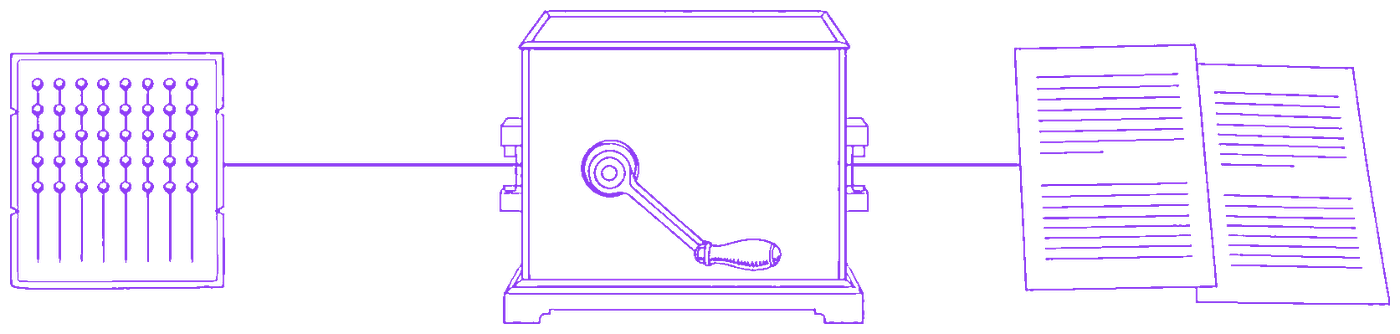
In the 1790s, Gaspard de Prony filled a room in Paris with sixty to eighty people and set them computing the logarithm tables of the new French state. They used nothing but addition and subtraction. Nine-tenths of them, by Charles Babbage’s account, knew no other arithmetic at all.
Logarithm tables were the computing infrastructure of the age: look up two numbers, add them, look up the answer, and a multiplication is done. Someone had to fill the tables in.
The people who did were the most accurate calculators in the building. Babbage records that they were “usually found more correct in their calculations, than those who possessed a more extensive knowledge of the subject.”
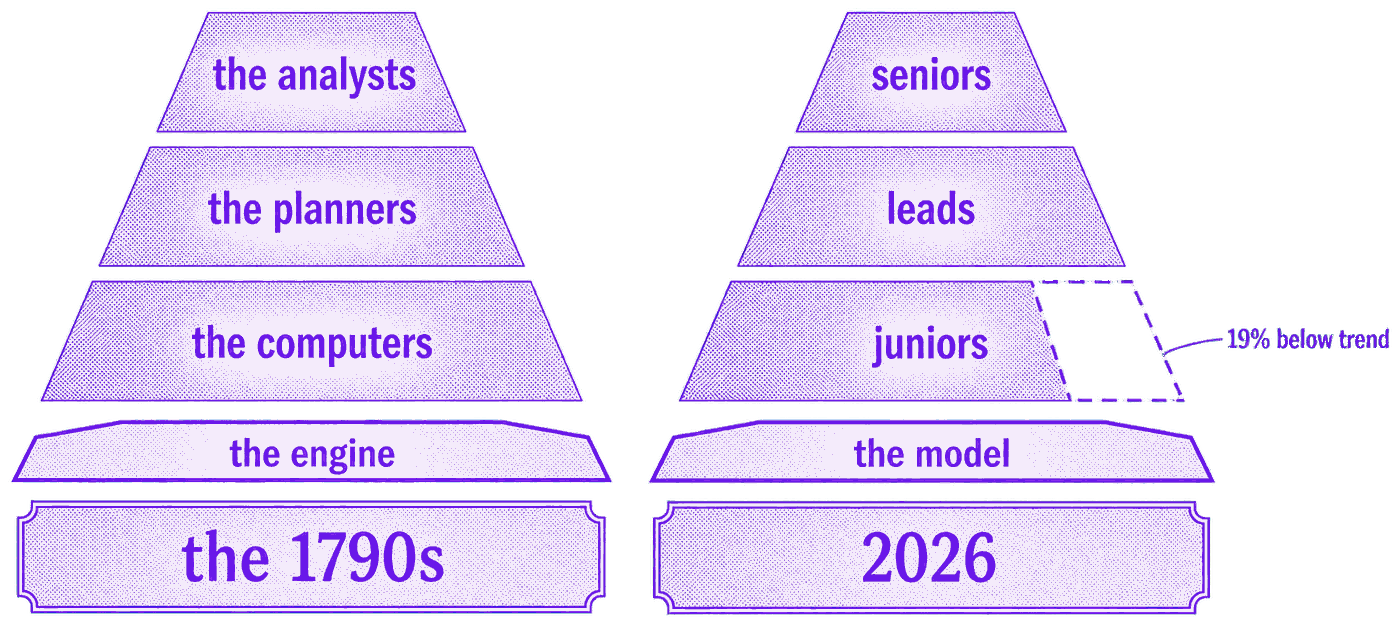
Above them sat seven or eight trained mathematicians who prepared the worksheets. Above those, five or six eminent analysts who chose the methods and never touched a number.
Three tiers. The bottom one did the thinking after the thought had been taken out.
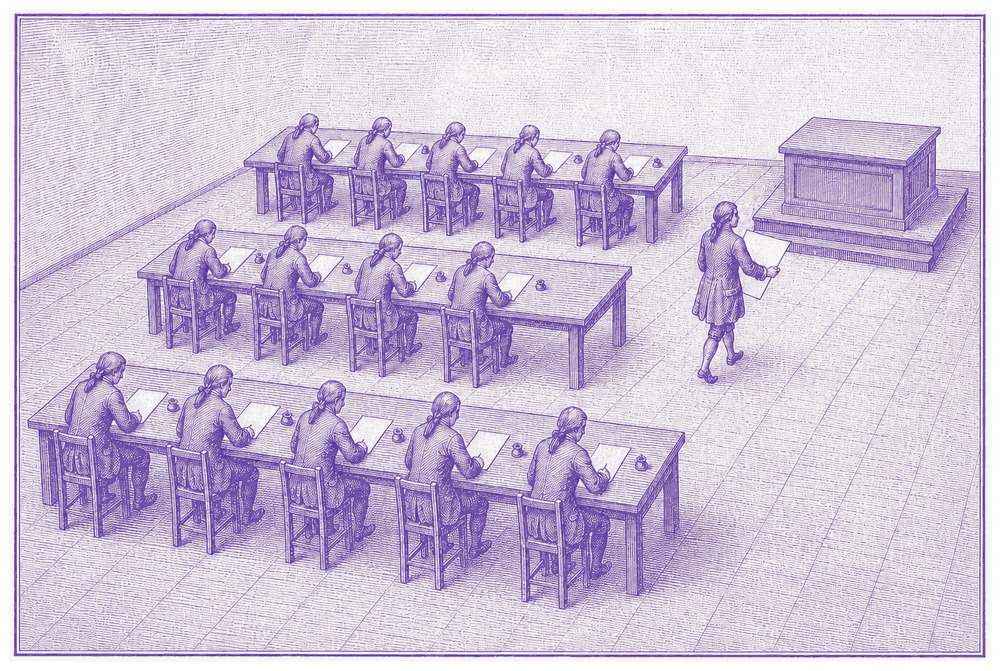
The story de Prony’s circle told, decades later, has him opening Adam Smith’s Wealth of Nations at the pin chapter and resolving to manufacture logarithms the way Smith’s workmen manufactured pins. The bookshop epiphany is probably polished. The method is not.
Smith’s pin numbers, published 1776: one untrained workman could “scarce, perhaps, with his utmost industry, make one pin in a day.” Ten men, splitting the work into about eighteen distinct operations, made upwards of 48,000.
The same book carries the warning. A man confined to a few simple operations, Smith wrote in Book V, “generally becomes as stupid and ignorant as it is possible for a human creature to become.” He was arguing for publicly funded schooling: he saw the cost of the machine he had just described, and printed both.
The gain and the damage shipped in the same volume.
Now the consensus reading of the present moment. Machines spent two centuries taking physical labour; crossing into reasoning and creativity is new, a rupture without precedent. Until a few years ago the belief was widespread that intellectual and creative work sat in a protected category, because the human mind was the one thing that could not be industrialized.
The history runs the other way. The division of labour was applied to cognition in the 1790s, within twenty years of Smith describing it for pins. AI is not optimization’s first entry into intellectual work. It is its return.
And the belief in the protected category is not a modern mistake. It is the pattern’s most reliable product. Wherever work can be tiered, the bottom tier is standardized first and mechanized next, and the belief re-forms one tier up, because the people drawing the line are always standing above it.
De Prony’s room was iteration one.
The plan was always explicit
Iteration two, 1903. Frederick Taylor, in Shop Management: “All possible brain work should be removed from the shop and centered in the planning or laying-out department.” Not a lament. An instruction.
The judgment a machinist carried was extracted, tabulated, and moved upstairs. His tier was told, in print, that its thinking belonged elsewhere.
And the machine itself was never an afterthought. In 1832 Babbage, who had studied de Prony’s project closely, stated what his calculating engine was for: “when the completion of a calculating engine shall have produced a substitute for the whole of the third section of computers, the attention of analysts will naturally be directed to simplifying its application.”
The tense is the cold part. When, not if. Replacing the bottom mental tier was a design goal, in print, 194 years ago.
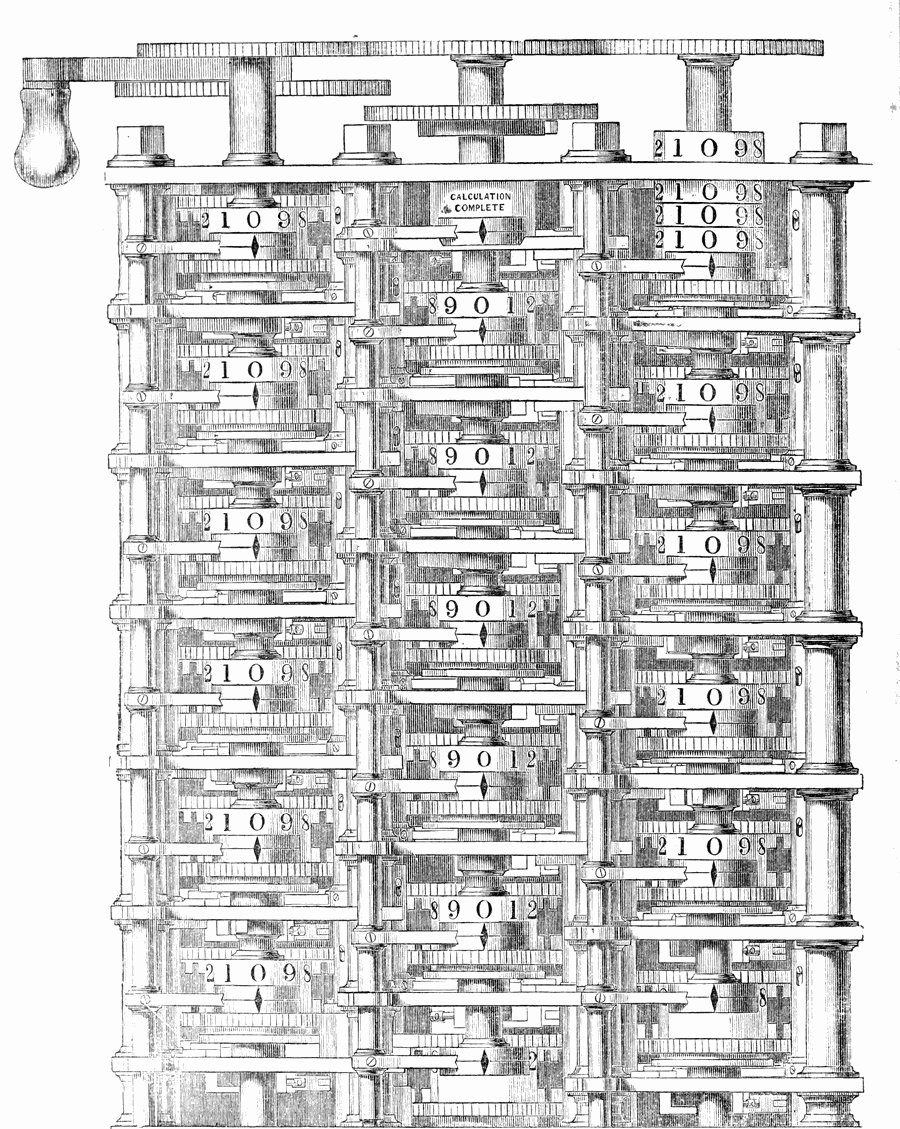
It just took longer than Babbage hoped. “Computer” remained a human job title into the twentieth century: Harvard Observatory employed more than eighty women computers between 1877 and 1919 at 25 to 50 cents an hour, and the WPA’s Mathematical Tables Project ran 450 human calculators into the 1940s.
Harvard also complicates the story, and honesty requires it. Williamina Fleming, Annie Jump Cannon, Henrietta Leavitt and Antonia Maury did first-rank astronomy from inside that bottom tier, under exploitative pay. Industrialized mental labour was never only degradation. It was also a door, priced insultingly low.
The line was drawn with care
Iteration three had something the first two lacked: a theory, written down with probabilities, to three decimal places.
Hans Moravec, 1988: “it is comparatively easy to make computers exhibit adult level performance on intelligence tests or playing checkers, and difficult or impossible to give them the skills of a one-year-old when it comes to perception and mobility.” A one-year-old. The claim is that the baby’s skills are the hard ones and the adult’s are the easy ones. Hold that thought; it comes back.
Why would that be true? Michael Polanyi supplied the era’s answer in 1966: “We know more than we can tell.” Most human competence is tacit. We can do it, and we cannot state how we do it. Anyone can recognize a face; nobody can write down the procedure.
The economics built directly on that. To automate a task, a programmer must write down the rules; tacit knowledge cannot be written down; therefore tacit tasks are safe. In 2015 David Autor, the field’s most careful empiricist, listed the canonical examples of work too tacit to specify: identifying a bird from a glimpse, developing a hypothesis, writing “a persuasive paragraph.”
And in 2013 two Oxford researchers, Carl Frey and Michael Osborne, turned the logic into numbers: 702 occupations, ranked by estimated probability of computerization. Choreographers: 0.004. Writers and authors: 0.038, scored safer than applications software developers at 0.042. Graphic designers: 0.082. Down at the doomed end, proofreaders at 0.84 and technical writers at 0.89.
The model rated writing prose, if only by a whisker, less automatable than writing code. And it rated originality safe and correctness doomed.
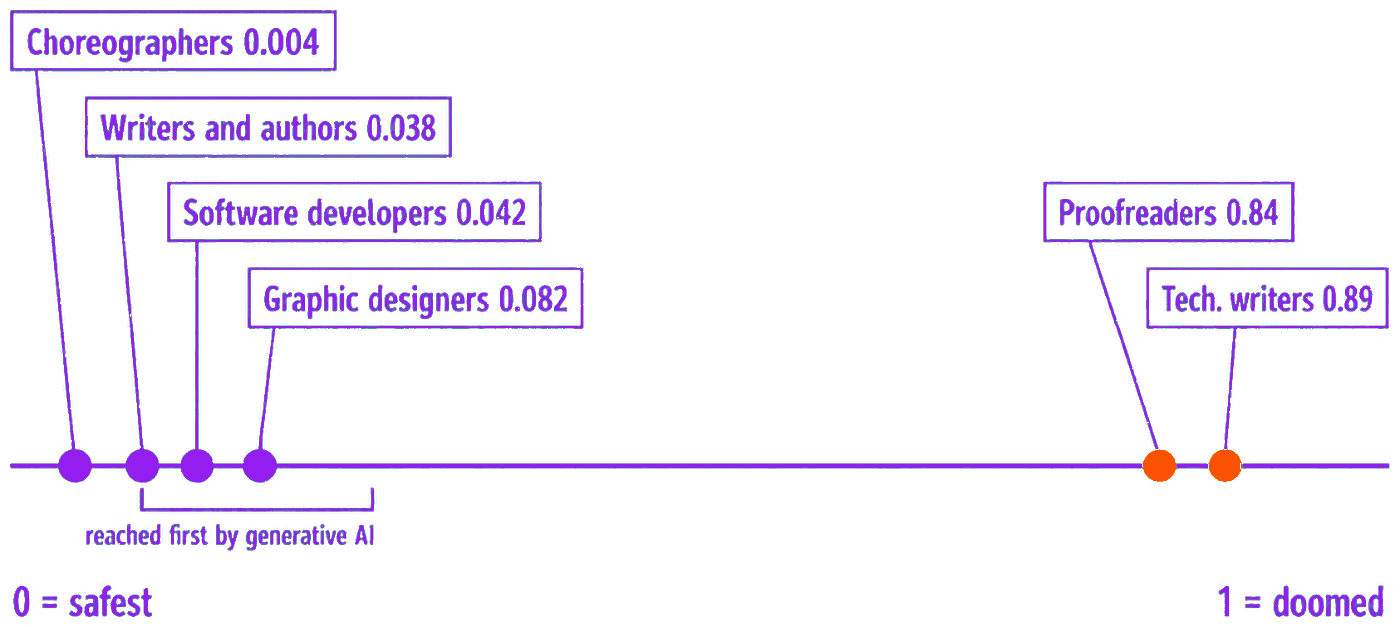
The line sat just above the modellers’ own kind of work. Again.
What the fallen occupations shared
Then generative models arrived and worked through the strip from the wrong end. Illustration, prose, graphic design. The plumbers are fine.
The first guess is the cynic’s: creative work was never really skilled, and the rankings flattered it. It does not survive the measurements. In a preregistered experiment on 453 professionals, ChatGPT cut average writing time by 40 percent and raised rated quality by 18 percent; consultants given GPT-4 produced more than 40 percent higher quality on tasks inside the model’s competence, and were 19 percentage points less likely to be right on a task outside it. Nobody measures a 40 percent quality improvement on work that contains no skill. The work was hard. Hard enough to fail at.
The second guess: the fallen tasks were secretly routine, rule-following work misfiled as creative. Also no. These were precisely the nonroutine tasks the standard economic model said computers complement rather than replace. The framework classified them correctly and still got them wrong.
So what did illustration, prose and design share that plumbing does not? Not low tacitness. An illustrator can no more state the rules of composition than a plumber can state the feel of a fitting about to seize. Both crafts are tacit to the bone.
What they shared is embarrassingly simple once seen: the internet held millions of recorded performances of them. Every finished illustration posted to a portfolio site, every essay, every logo and book cover, uploaded, public, scrapeable. A plumbing job is performed once, in a crawlspace, for an audience of zero, and the performance evaporates.
Frey and Osborne nearly had it. Their own paper says: “generating novelty is not particularly difficult. Instead, the principal obstacle to computerising creativity is stating our creative values sufficiently clearly that they can be encoded in a program.” Their bet was that nobody could write those rules down, and they were right. The models never wrote them down. Trained on millions of examples of finished human work, they absorbed our preferences as revealed rather than stated.
The wall was not climbed. It was walked around.
So the protective property changed identity, silently. It was never “hard to explain”. It was “rarely recorded”. The two coincided for the entire history of automation, so nobody ever needed to tell them apart. When they came apart, every map drawn on the old property pointed the wrong way, and wrong in a specific direction: it marked as safest exactly the work with the richest public record.
That is why the forecasts did not merely fail. They inverted.
The honest objection is hindsight. After the fact, some property always fits the outcome, and picking recordedness in 2026 is easy in a way it was not in 2013. So it has to be stated the way the 2013 map should have been: as a hypothesis with its own way of dying.
If an occupation with a massive public record of performances stays unautomated for capability reasons, or an unrecorded, embodied craft falls without anyone first building the dataset, then recordedness joins the appendix in the museum of confident maps. And the line it draws holds only as long as nobody records the performances. The moment embodied work is filmed at scale, video becomes training data like any other.
And the one-year-old, back off the table. Moravec’s paradox has aged into its mirror image: the baby’s skills, perception and mobility, are still standing while the adult’s showcase skills fell first. His sentence turned out right for a reason he could not have stated in 1988. The baby’s skills are not just unarticulated. They are unrecorded. Nobody uploads labelled performances of toddling across a cluttered room.
The landing zone
The method broke precedent, then. The landing zone did not.
The best current evidence is payroll. In August 2026 Stanford’s Digital Economy Lab published an analysis of ADP records, actual paychecks covering millions of US workers through June 2026, and found no evidence of widespread, economy-wide job displacement. What it found instead: employment of workers aged 22 to 25 in AI-exposed occupations, software development and customer support among them, stood 19 percent below where it would be had it kept pace with their less-exposed peers.
Experienced workers showed no comparable gap. The effect runs through reduced hiring of the young, not through firing anyone. It was 15 percent in the July 2025 data, 19 percent by June 2026, and the authors call these figures “canaries in the coal mine”. Early, descriptive, not causal proof.
The rupture story predicts nothing about that shape. If machines had just breached a wall that held for all of history, the damage could land anywhere. The de Prony pattern predicts precisely this: bottom tier first, entered quietly, through doors that stop opening rather than people marched out of them.
That is also how this essay would be proven wrong. If later vintages show displacement arriving mainly as separations of experienced workers while entry hiring holds, the pattern described here is broken. So far every vintage shows the opposite.
The person, repriced first
Which leaves the part the payroll cannot see.
Set the narrowed door aside for a moment. For everyone already inside the room, the measured damage, so far, is small. On the most exposed freelance slice, copyediting, proofreading and graphic design, contracts fell about 2 percent after ChatGPT’s release and earnings about 5 percent. One platform, a short window, an upper bound. Now the other column. In an October 2024 Pew survey of 5,273 employed Americans, 52 percent were worried about AI’s future impact on their work, and 33 percent felt overwhelmed by it. In Chongqing, a game studio cut 5 of its 15 character-design illustrators after adopting image generators; Amber Yu, a freelancer who had earned 3,000 to 7,000 yuan per game poster, was afterwards paid about a tenth of her old rate to fix the AI’s output.
A 2 percent contract decline against half a workforce worried.
The reaction is an order of magnitude larger than the damage.
The obvious reading is overreaction: hype, panic, loss aversion doing its usual work. That reading has one virtue, arithmetic, and one flaw. It cannot explain who is most afraid.
A 2022 study of 206 medical students and physicians measured professional identity threat: the perceived challenge not to a person’s income but to what makes their profession worth belonging to. The students, who had never practiced, reported stronger threat and stronger resistance to medical AI than the working physicians did. Anticipated threat exceeds experienced threat, and the same study found the pattern reverses when AI is framed as comfortably distant. Proximity is what arms it.
Economic fear should not look like this; it should peak where the losses are realest. Instead it peaks before contact.
So ask directly: what predicts the threat? In 2022, researchers asked 303 employees who already worked with AI, using a model that tests several candidate causes at once and reports which ones carry weight. Two predictors held: anticipated loss of status position, and changes to the work itself.
Threat to job security predicted nothing. Neither did loss of skills, loss of autonomy, or loss of control.
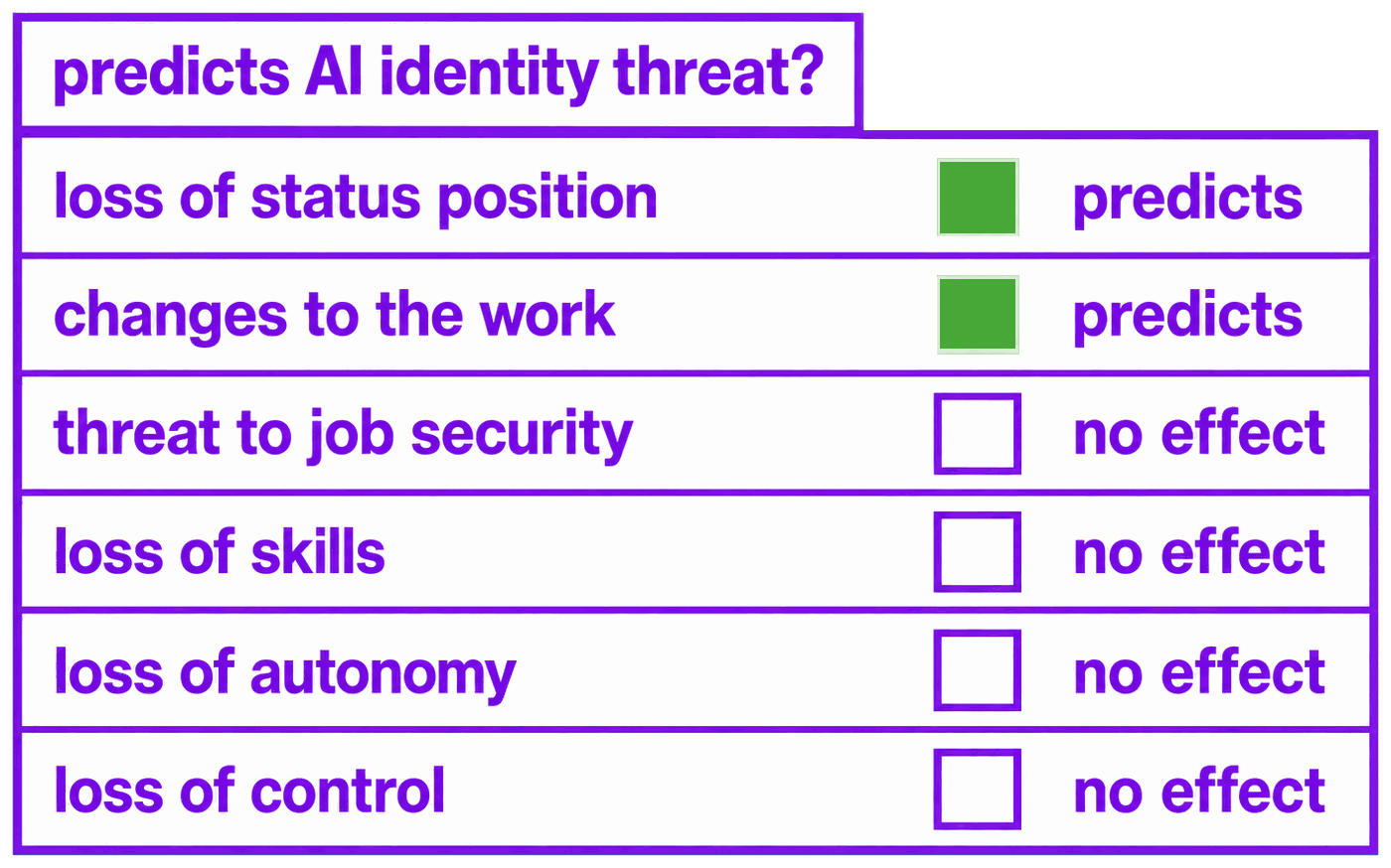
The null is the finding. Prose can say “did not predict”; only the missing bar makes the absence something the eye verifies.
Here the two columns reconcile. The AI shock to knowledge and creative workers has been, so far, primarily an identity event, not an economic one. The injury is large because it was never mainly about the payroll. Work is identity infrastructure: psychology counts competence among the basic human needs, alongside autonomy and relatedness, and thwarting it degrades motivation and wellbeing. The unemployment literature has known for decades that joblessness damages people far beyond the lost pay. Mental distress runs twice as high among the unemployed, income plays no strong role in the difference, and “an enormous amount of extra income would be required to compensate people for having no work.”
What generative AI removed first was not the jobs. It removed the exemption story. A profession can keep every contract and still lose the account it gave of why it could not be automated.
The claim needs its honest counterweight, and its own way of being wrong. The missing first jobs of the 22-year-olds are real money for real people, arriving now, and the job-security null is one pre-generative snapshot, thin evidence of absence. So the claim is about sequence, not safety: the injury came first, out of proportion to the numbers, along the status axis rather than the income one. If identity threat tracked displacement risk across occupations, loudest where the losses are largest, this essay is wrong. Nobody has run that comparison across occupations yet; what exists, status predicting what job security does not, and the students out-fearing the physicians, points the other way.
The person was repriced before the payroll.
I keep coming back to one phrase for what this feels like from inside: a rather brutal return to Earth. Skills bound up with status, identity and a sense of human uniqueness, suddenly subjected to the same productivity calculus that transformed manual labour.
Go back to the third-section room one last time. Sixty to eighty people doing intellectual work, more accurate than their educated superiors, their tier already drawn, their replacement already planned in print. Nothing in that room was physical labour. It was cognition, manufactured, more than two centuries ago.
The room still exists. Its bottom tier is called juniors now, and there are 19 percent fewer of the young in it than there should be. One tier up, the old belief is re-forming on schedule: that this tier, the one doing the judging, is where the pattern finally stops. It formed over the computers. It formed over the shop floor. It formed inside the 2013 appendix, three decimal places deep.
And in Chongqing, in the earliest reporting we have, Amber Yu was still working: paid a tenth of her old rate to fix the machine’s output, the kind of entry that rounds into a 2 percent decline on someone’s spreadsheet.
Her job survived first contact. The story her craft told about itself, the one where a machine could not do this, did not.
That story is re-forming now, one tier up. It always does.
Curiosity of the week
Quote of the week
“In the past the man has been first; in the future the system must be first.”
Frederick W. Taylor, The Principles of Scientific Management (1911); his next sentences insist the system's first object is developing first-class men