marco@blog.luyckx.dev:~$ cat the-kolmogorov-school.md
The Kolmogorov School
$ git log --follow the-kolmogorov-school.md 1 edition
First published.
$ grep '^#\+' the-kolmogorov-school.md 7 headings
In 1962, Andrei Kolmogorov wrote a letter arguing against schools for geniuses. Special schools for outstandingly gifted children seemed to him inappropriate, because a child’s real specialisation is usually settled later; what the country should build instead, he wrote, was a mass network of physics and mathematics classes, entered by open competition, 100,000 to 150,000 students a year. A year later he co-founded the most famous genius school ever built, Moscow’s Boarding School No. 18, enrolling about 150 students a year. Either the greatest probabilist alive changed his mind within twelve months, or the school was a compromise with the defence ministries that funded it.

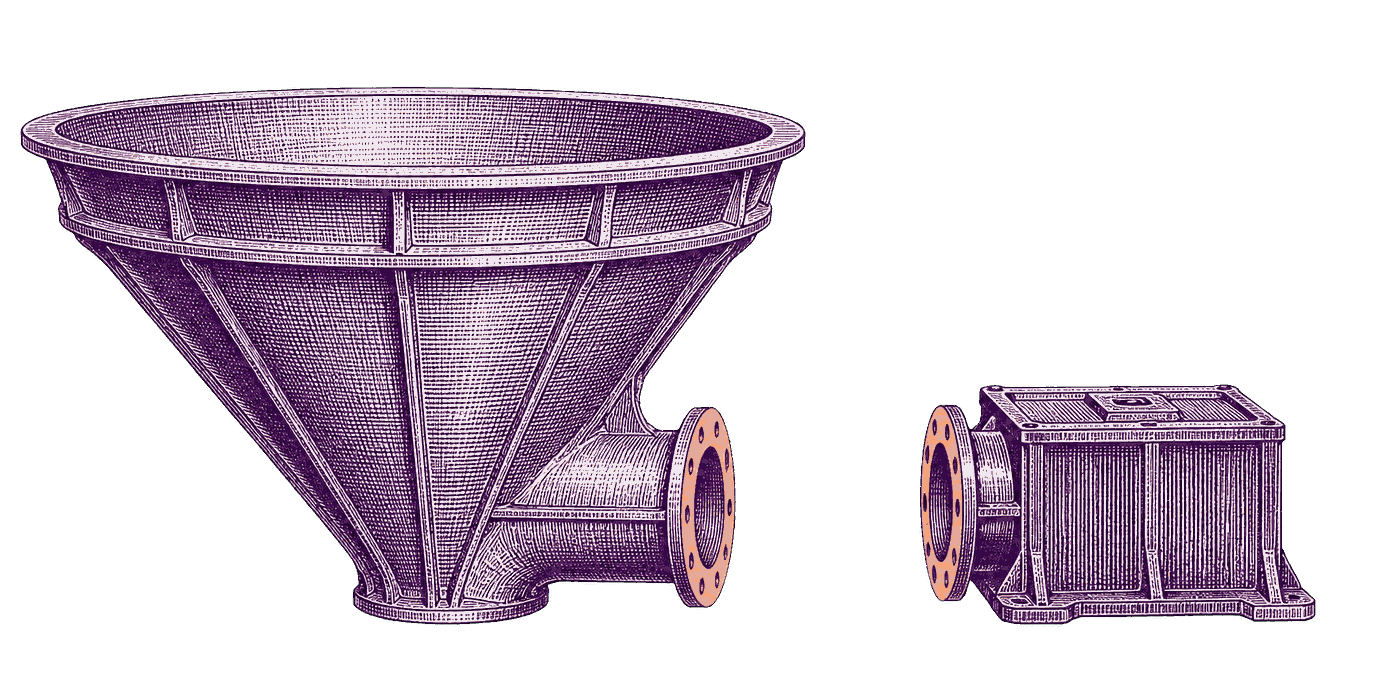
For a long time I read that letter as an irony. I now read it as an unassembled machine. The letter describes a funnel: wide, national, cheap. The school he was handed is a house: small, residential, total. The century of genius schools kept mistaking these for rivals and building one without the other, and neither works alone: the funnel finds children and does nothing to them; the house cannot honestly fill itself, because the children it wants cannot be identified in advance, only attracted. Kolmogorov asked for the funnel, was handed the house, and both were right, and nobody ever joined them.
This essay assembles the machine. It designs a school, The Kolmogorov School, a boarding school for ferociously driven children, and holds it to one standard: every load-bearing part must survive the published evidence about places like it. I nearly named it the Ambition School, and the rejected name still describes the admission criterion better than any test does; the name it carries honours the man who wrote down both halves of the problem. The design is deliberately imaginative: it is what I would build; the imagination runs on a leash, and the leash is the record.
Two beliefs stand in the way. The first is that designing a school for geniuses starts with the curriculum and the teachers. The second, held by more careful people, is that such designs are utopian fantasy, unfalsifiable by construction. Both are wrong in instructive ways, so here is the thesis in one breath. A school for geniuses survives the evidence only as a complete system: a wide national funnel that selects appetite rather than measured genius, feeding a residential peer engine at adolescence, governed by floors rather than paths, bounded by an engineered exit, and run as an experiment that can fail in public. Remove any one element and the design collapses into one of its failed predecessors, each of which has a name and a file.
Five ways a genius school dies
The file is thick, and its lesson is not that genius schools fail; it is that they fail in five distinct, independent ways, and fixing one does nothing about the others. The first death is selecting the wrong thing: Lewis Terman’s life-long study of 1,500 high-IQ Californian children is its monument. The second is having no mechanism: the most celebrated selective schools in the world add almost nothing to the students they admit; their fame is the fame of the students they chose. The third is poisoning the motive: a school that mandates the passion it selected for extinguishes it, and the effect bites hardest in children. The fourth is boundary damage: the wreckage in the record, John Stuart Mill’s collapse at twenty, the Soviet graduates leaving their boarding schools for what one called airless space, sits almost never in the middle years and almost always at the walls, at entry and above all at exit. The fifth is unfalsifiability: from Boris Sidis in 1911 to László Polgár in 1989 to a $40,000-a-year school in Austin advertising doubled learning speed from its own unaudited spreadsheet, not one of these projects could ever have been proven wrong.

Five deaths, five answers, and the answers form a system, not a list: each element patches a hole another opens. The funnel supplies the cohort the peer engine needs; the floors protect the appetite the funnel selected; the exit absorbs what the engine concentrates; the funnel’s overflow makes the whole design testable. The rest of this essay is the five answers and the joins between them, and the joins are why the design is all or nothing.
The engine
The deepest objection comes first, because if it stands, everything after it is furniture. Its strongest standing version was written, in a private irony, by Bryan Caplan, on whose blog I found the ambition pedagogy the design later borrows.
The argument runs through behavioral genetics, whose workhorse method is to compare pairs of people of known relatedness raised in known arrangements: identical twins share all their genes, fraternal twins half, adoptive siblings a home and none. The comparisons split human differences into three buckets: genes; the “shared environment” that makes children raised together more alike, home, parents, income, and usually school; and a remainder. Eric Turkheimer compressed four decades of this work into three laws, and the second is the killer:
The effect of being raised in the same family is smaller than the effect of genes.
Caplan’s synthesis supplies the metaphor:
Children are not clay but plastic, flexing under pressure and popping back once it is released.
Parenting effects on long-run outcomes are largely temporary. A school is shared environment too, and it fades with the rest. On this reading the twin studies are a verdict on every school prospectus ever printed.
But the definition has fine print. “Shared environment” is whatever makes two children raised together more similar, and nothing else; two siblings at the same school do not share the thing that matters most to a teenager, one sitting with the chess players, one with the footballers, same corridors, different planets. The peer group, the force that decides what is cool, what is shameful, what counts as normal effort and ambition, lands almost entirely in the remainder bucket, which by Turkheimer’s own accounting holds about half the differences between siblings. Judith Rich Harris built a theory there: within the range of families studied, parental behaviors have no effect on the characteristics children carry into adulthood, and the socialization credited to parents happens in peer groups. Her thought experiment makes it physical:
Children would grow into the same adults if they kept their homes, schools, neighborhoods and peer groups while all the parents were switched overnight.
What it holds constant is the tell: she switches the parents and keeps the friends.
Two honesty clauses belong beside this. Turkheimer himself insists the nihilist reading of his laws is incorrect, the apparent systematic power of genes being partly an artifact of method. And twin and adoption studies see only sampled environments, screened by adoption agencies into stability and similarity, which shrinks the measured effect of home; no registry contains children whose entire social world was replaced at thirteen. The peer loophole is a loophole, not a proof; the design is a bet placed on it, and the last movement exists because bets must be settleable.
By the method’s own bookkeeping, at most one environmental channel survives, and exactly one institution replaces a child’s peer group wholesale rather than renting better classmates for six hours: the boarding school. The peer group is the curriculum; teaching, buildings and method are mostly selection theater, and the evidence is coming.
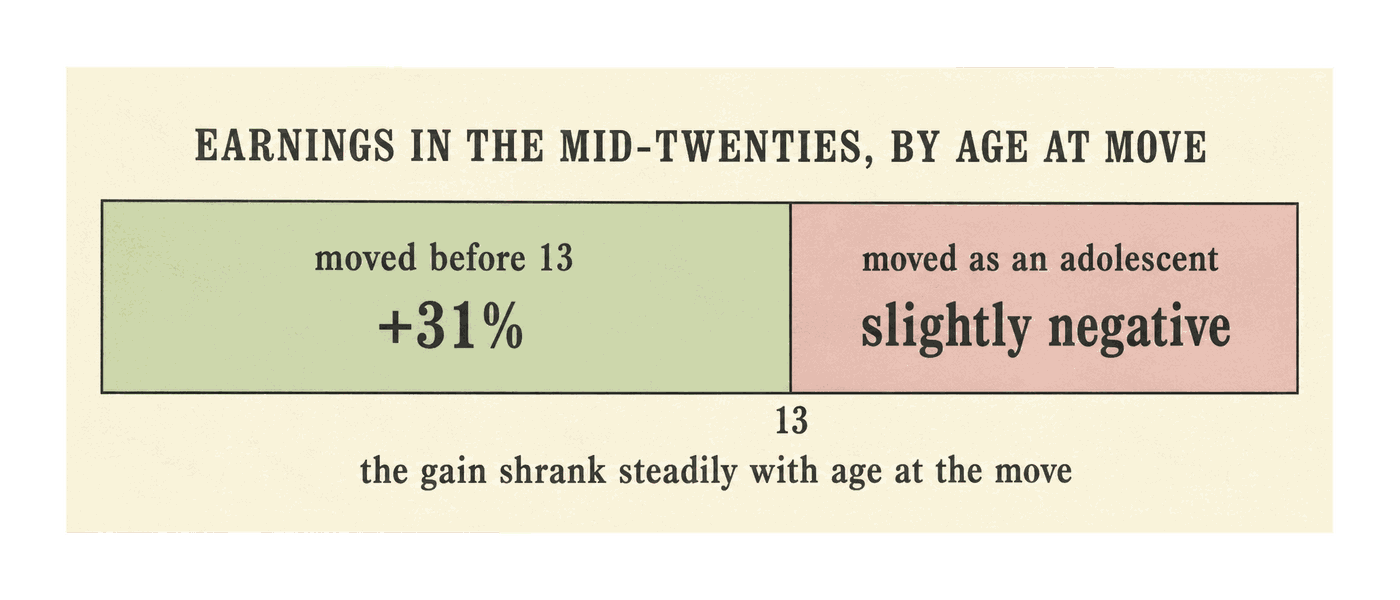
If the peer group is the treatment, timing is dosage. Blakemore and Mills report that the brain regions handling social information reorganize through the second decade, and propose, hedging preserved, that this may be a sensitive period for adapting to the social environment. The behavior is firmer than the mechanism: susceptibility to peer influence peaks in early adolescence, and in one experiment the mere presence of friends raised adolescents’ driving-game risk-taking and left adults’ unchanged. The economics agrees: when the Moving to Opportunity experiment moved poor families to better neighborhoods, children who moved before thirteen earned 31 percent more in their mid-twenties, the gain shrank with age at the move, and adolescent moves showed slightly negative effects, attributed to disruption. That warning shot bounds the window: early enough for exposure to compound, before the peak of peer sensitivity, not on top of it. The evidence gives a window, early adolescence, and nothing sharper; any particular year is a design judgment, not a finding. My judgment is that the doors open around thirteen; Kolmogorov’s own school admitted at fifteen or sixteen, late by this clock, though that reading too is judgment.
Now the exemplar. From 1963, Boarding School No. 18 enrolled its 150 a year, recruited deliberately from the provinces. Kolmogorov taught there for years, up to 26 hours a week; he wrote the syllabi, lectured the students on music, art and literature, and led forty-kilometre Sunday hikes, on the stated principle that intellectual development must be evenly balanced. Told the usual way, that is a story about teaching; told through the second law, every detail reorganizes around the mix. The recruiters combing distant towns were composing a peer group that could never have assembled itself, gathering the one mathematics-obsessed child from each of a hundred towns into a single dormitory, where the group’s norms could rewrite what counted as normal effort and ambition. The music and the hikes are shared culture and shared exhaustion, solvents for fusing strangers into a tribe; even the teaching hours are signal: a tribe that gets Kolmogorov’s Sundays is worth belonging to. The classroom was the school’s theater. The dormitory was its mechanism.
Is there a causal trace, or only a prettier story? Many selective schools admit by a score cutoff, and the cutoff accidentally creates an experiment: the student one point above the line and the student one point below are, in expectation, the same person, so any later difference between them is the school’s causal effect. Abdulkadiroğlu, Angrist and Pathak ran it on Boston’s and New York’s exam schools, where crossing the cutoff at Stuyvesant lifts the average math score of a student’s peers by roughly half a standard deviation, and found the effect on the marginal admit to be approximately nothing, precisely enough to rule out even modest peer effects; most of these students, they wrote, would likely have done well without the benefit of an exam school education. Dobbie and Fryer sharpened it: 64 percent of New York City students reaching Harvard, Princeton or Yale came from three exam schools that add nothing at the margin. This is the Elite Illusion, the second death in the file, and if the peer group is the curriculum it looks fatal. It is not, because of the dose. The marginal day student in those studies keeps his home, his old friends, his evenings; his social world is amended for a few hours, not replaced. And he enters the new distribution at its bottom, where the group reads back a diminished account of him: across 1.28 million students, being surrounded by high achievers lowers academic self-concept by a standardized 0.28, the big-fish-little-pond effect, self-belief rather than achievement. The cutoff studies measure a partial dose, at the least favorable margin, on a student whose old world stays open behind him; they answer a question this design is not asking.

The residential evidence answers the question it is asking. Kenya’s elite national secondary schools carry the same reputations, and the same cutoff method collapses their apparent advantage from 0.30 standard deviations to under 0.05, with one exception: Swahili rose by a quarter of a standard deviation. The national schools board their students, drawing every region and ethnic group into one residence, and Swahili is the lingua franca of the dormitory; the one skill the schools demonstrably produced is the one their peer mixture, not their teachers, was positioned to teach. The mechanism left a fingerprint. The rest of the boarding literature: the largest study, of 5,276 Australian adolescents, found predominant parity, its authors conceding the modest positives vanish once pre-existing differences are counted, and the boarding sector part-funded it; a 49-study meta-analysis found 0.002 overall, a cognitive gain of about a quarter of a standard deviation against an affective loss of about a sixth. And when an urban American boarding school for low-income students admitted by lottery, Curto and Fryer measured gains of about 0.21 standard deviations in reading and 0.23 in math per year. Overall, parity holds, the 0.002 stands; but the causal traces that do appear, gains and harms alike, appear where residence itself is the treatment. An engine, not a blessing.
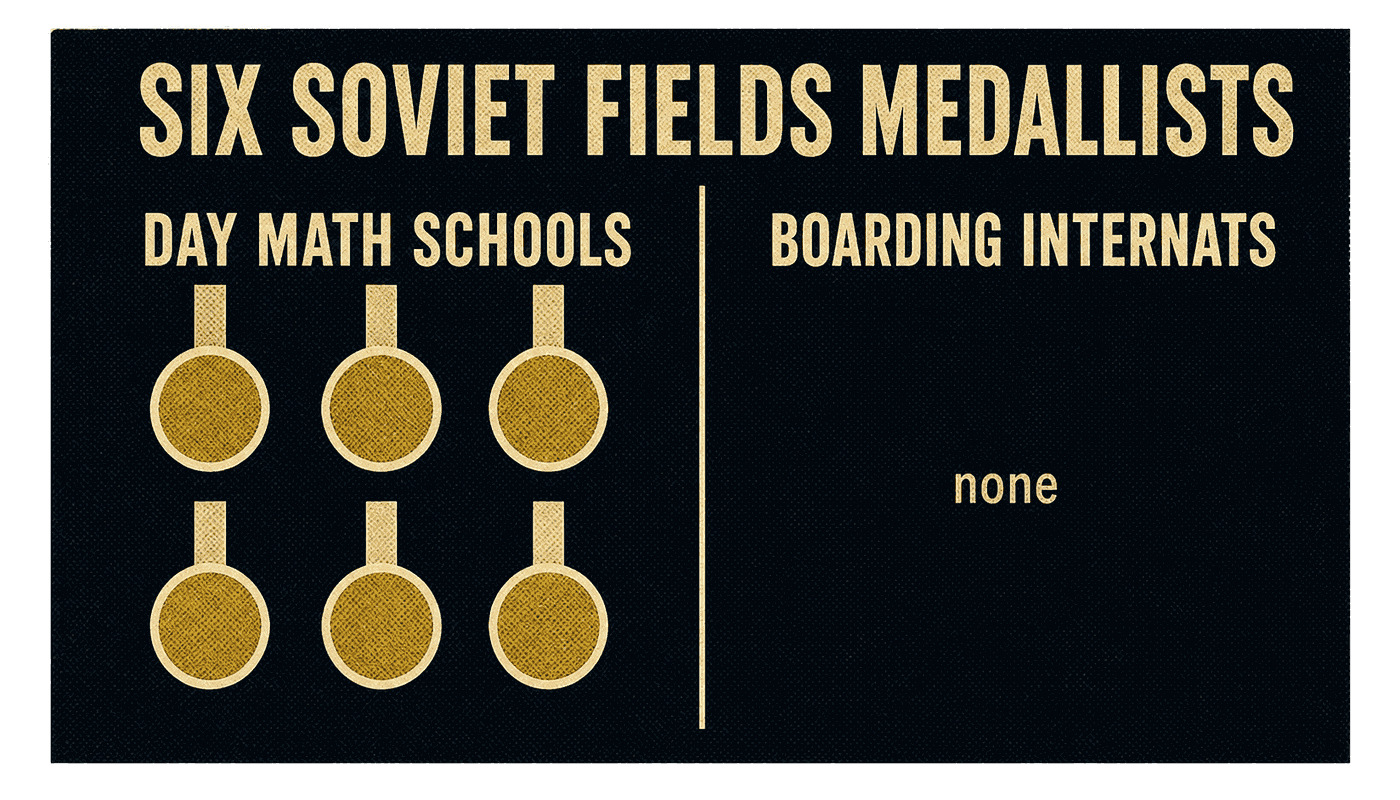
Now the strongest counter-data against my own exemplar. By a 1999 estimate, 80 percent of Russia’s professional mathematicians were graduates of specialised math schools. But the six Soviet-educated winners of the Fields Medal, the closest thing mathematics has to a Nobel Prize, came from day math schools, all six, and not one from the boarding internats. Selection could explain it; the internats recruited from a provincial pool, the day schools sat in cities dense with talent, and nothing in the record rules that out. It is the counter-data to weigh hardest: the porous version of the design produced the extreme tail, and the sealed version produced something else, whose exit files the fourth movement reads. So the engine’s claim is stated modestly and exactly: a residential peer engine at the adolescent window is the one school design with a surviving causal mechanism for shaping who its students become. The record does not show it manufacturing medallists, and this design does not promise to.
And engines have no neutral setting. When the internat’s students went on hunger strike in January 1973 over a ban on dancing, the authorities expelled two ringleaders and restricted university admission for the whole graduating class; by 1976 Leningrad’s party leadership was closing math schools as hotbeds of the intelligentsia. Concentrated adolescents develop norms, and the norms are theirs: the state built a cadre factory and got a solidarity machine, the mechanism working in a direction its funders despised. Such an engine needs feeding carefully, governing lightly, and exiting deliberately.
The funnel
The house is only half the machine, and the harder half is filling it. For the 1985 study Developing Talent in Young People, Benjamin Bloom’s team interviewed 120 world-class performers, and the parents kept telling the interviewers the same strange thing: a different child of ours had more natural talent. The one who reached the top was often not the one the family would have bet on, and Bloom estimated that at eleven or twelve, ten percent or fewer had progressed far enough for anyone to predict their eventual attainment. The intuitive answer, test early and skim the top, ran sixty years at full scale.
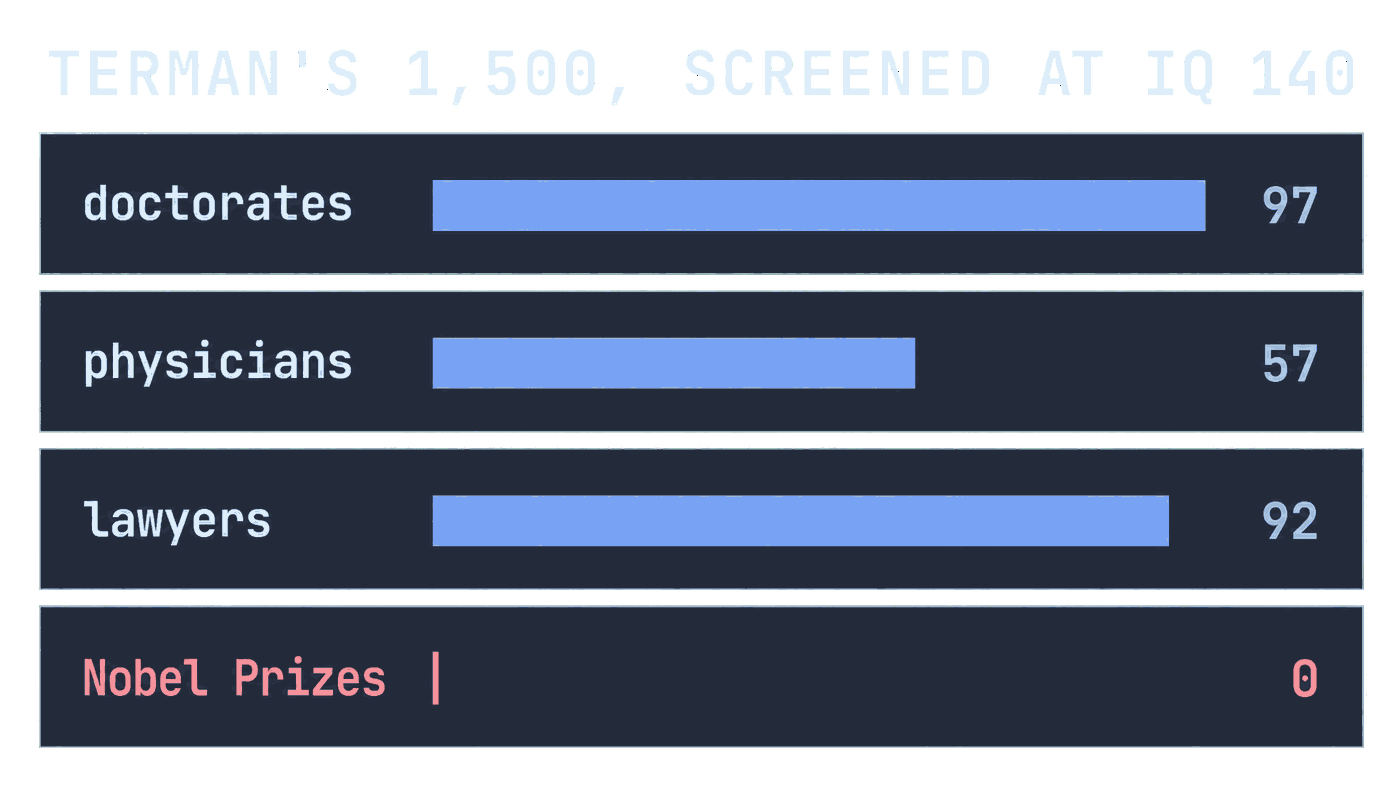
In 1921 Lewis Terman combed California for children with IQs above 140, gathered about 1,500, and followed them for life. They prospered, 97 PhDs, 57 MDs, 92 lawyers, degrees at ten times their era’s rate, and not one Nobel Prize, while two boys from the population he screened, William Shockley and Luis Alvarez, won Nobel Prizes without making his sample. The missing Nobels read as an embarrassment for the IQ test until Russell Warne simulated Terman’s selection in 2020 and found something colder: Terman had between a 53 and an 83 percent chance of missing both future laureates by chance alone. Outcomes that rare, with measured intelligence so far from their only ingredient, scatter across the upper range of the scale rather than stacking above any line; draw the line at 140 and those are the odds of missing both. The miss is not measurement error; it is what a threshold does to a rare event, and no sharper instrument fixes the arithmetic.
Prediction has a second, independent failure at the top: the target moves. Across nineteen datasets and 34,839 adult international performers, junior elites and senior elites are nearly 90 percent different people; 82 percent of junior internationals never reach the senior level, and 72 percent of senior internationals were never junior internationals. The caveat travels with the number: junior status still multiplies the odds of senior success nearly fifty-fold; the groups are mostly strangers because almost everyone starts outside both. Worse is the direction of the predictors: across six thousand athletes, the traits that predict junior success are opposite in sign to those that predict senior world-class performance, the eventual world-class having started their main discipline later, logged fewer childhood hours in it, and done more coach-led training in other domains, while unstructured free play predicted nothing. A genius at twelve is mostly a child who is ahead at twelve.
The strongest objection: ability testing is not astrology. The Study of Mathematically Precocious Youth has been giving the SAT to twelve-year-olds since 1971, and of those who scored 700 or more, half went on to doctorates against a national base rate of one percent: a two-hour test forecasting at fifty times chance. An independent replication on Duke’s talent-search sample found 37 percent with doctorates by age forty, though that sample carries a filter the headline omits: parents opted these children into a paid talent search. Both facts must be held at once. The test predicts attainment with startling power, and it still cannot pick the eminent tail: a doctorate is a one-in-a-hundred event, and a fifty-fold lift turns it into a coin flip, while the tail a genius school exists for is rarer by orders of magnitude, and the same lift still leaves approximately nothing.
If the tail cannot be picked, it must be attracted, and one country demonstrated how, by accident. The Budapest miracle, von Neumann, Wigner, Szilard, Teller, von Kármán, Erdős, is usually credited to a legendary gymnasium; in fact the names scatter across at least four schools, Erdős was tutored at home, and Tibor Frank, the leading historian of the cohort, flatly refuses the great-school explanation. What every one of them could touch was cheaper than a school: the Eötvös competition and the problem journal KöMaL, both founded in 1894, both open to any secondary student in the country. Erdős, asked about the journal, said this:
Many of the good mathematicians realise very early that they have ability.
That sentence describes an identification device, not a training device. Hungary did not find its geniuses. It printed problems, monthly, nationally, and watched who could not stop solving them. The funnel was the sieve.
This is where Kolmogorov’s letter stops being an irony and becomes a specification. His 100,000-student network of competition-entered classes and his 150-student house were never rivals; they are stages of one machine, each the answer to the other’s fatal flaw. The house needs a cohort of the genuinely ravenous, which no test can identify; the funnel surfaces them by self-selection, for the price of printing problems, and the house is the one design with a mechanism for what it surfaces. So The Kolmogorov School resigns from the job everyone assumes is its first. It does not find geniuses; it makes itself impossible for them to miss. Upstream, open competitions and journals in every domain the school teaches, free, national, monthly. Admission is the competition plus proof of obsession: the problems solved, the thing built, whatever the child could not be stopped from doing. Terman’s own files endorse the criterion: his most and least successful men barely differed in IQ, and what separated them was confidence, persistence and early encouragement. The scarce input was never measured brilliance. It is appetite, and appetite does not show up on a test; it shows up at the door. And a national funnel feeding 150 beds surfaces far more qualified children than places; that overflow looks like the design’s tragedy, and the fifth movement shows it is the instrument.
The floors
The four founding rules of this school were mine; they predate the evidence. A child who loves mathematics does twenty-five hours of it a week, and nobody forces history on him. No passive consumption; creation is the test. Sport every day. No sitting desks. I wrote them believing a radical school means radical freedom. The evidence broke all four rules, and it broke them in the same place.
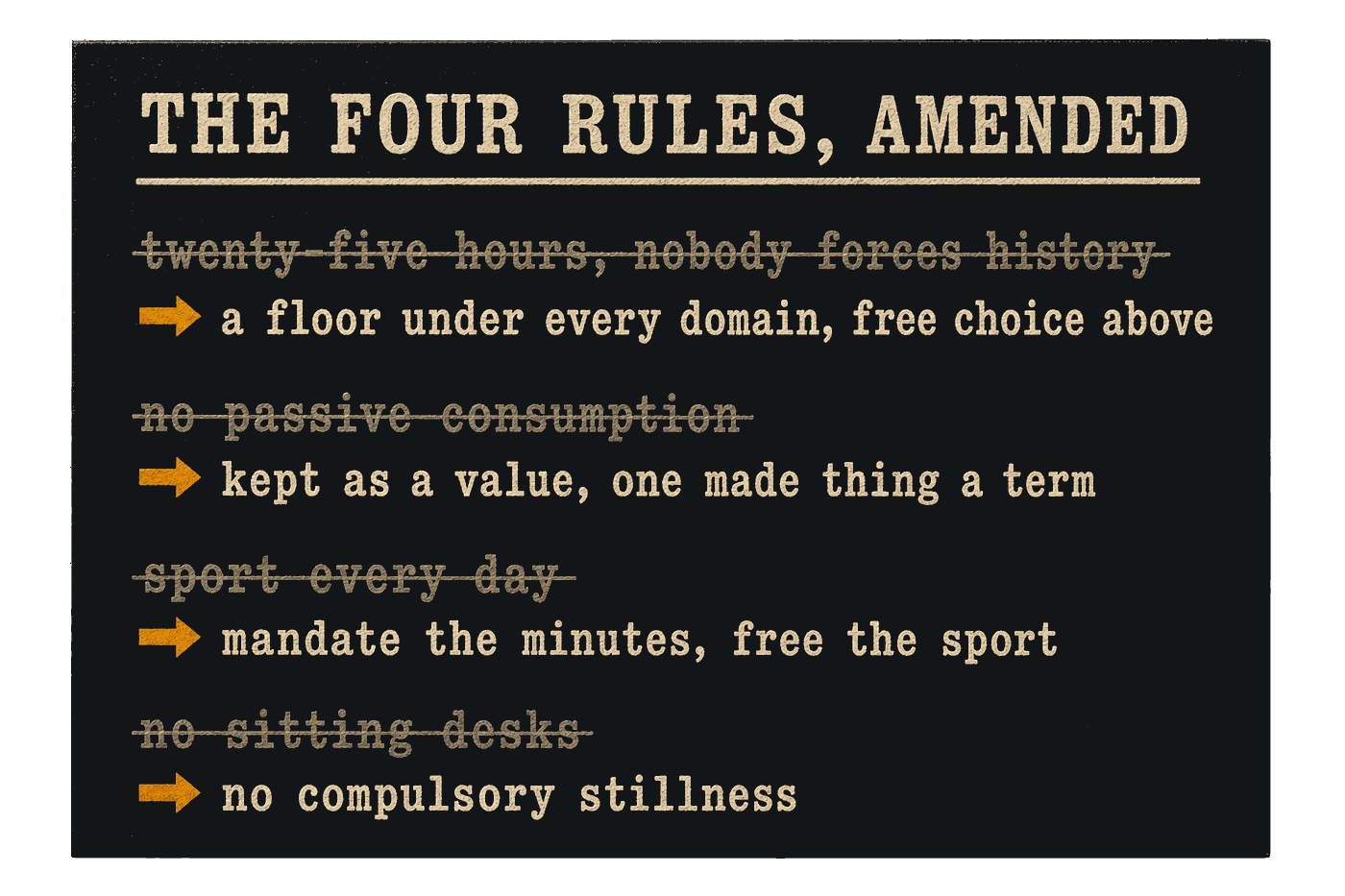
Free allocation first. The decisive meta-analysis on discovery learning covers 164 studies and splits cleanly: children left to discover material unassisted do worse than children given explicit instruction, an effect of -0.38, nearly a two-fifths standard-deviation penalty, while children whose discovery is scaffolded, freedom with guidance built underneath it, come out ahead at +0.30. Unassisted freedom fails; supported freedom wins; the operative variable was never freedom. Interest behaves the same way: in the standard four-phase model of interest development, a theoretical model rather than an experimental result, the early phases are externally triggered: a child’s love of a subject begins as something another person put in front of him. A child never shown history does not refuse history; he never meets it. Even my number was suspect: elite competition-selected young musicians practise about seven hours a week, music rather than mathematics, so the figure informs the twenty-five-hour rule rather than refutes it; but nothing anywhere demands twenty-five. The rule survives amended: an exposure floor on which every child meets every domain, briefly and taught properly, and above the floor, free allocation. The twenty-five hours of mathematics are still available. Chosen, not assigned.
The other three rules fall to one body of work. In 1973, researchers at a Stanford nursery school studied children who already loved drawing; some were promised a Good Player Award for it, and their free-choice drawing afterwards roughly halved. Psychologists call this the overjustification effect: hand a child an external reason for something he had an internal reason to do, and the internal reason does not survive the audit. The field’s meta-analysis puts tangible rewards at -0.30 against later intrinsic motivation, and the effect is significantly larger in children than in college students, -0.46 against -0.21.
The joint with the last two movements: the funnel admits children on demonstrated appetite, the one thing the tests cannot see; the peer engine runs on that appetite; and overjustification is the process by which a school converts appetite into compliance, every mandate wrapping an external reason around an internal one until the wrapping corrodes it. A school of mandates would spend its residential years dismantling the very trait its funnel was built to select. The floors exist because the mandates would otherwise poison the peer-chosen life. The same literature supplies the constructive half: in classrooms autonomy support and structure are complements, both predicting engagement; structure under the child, choice inside it.

Create, don’t consume: honesty first, because the empirical backbone this rule would like, the distinction between active and passive screen use, has collapsed, its originating researchers retreating in print in 2022. So the school keeps the rule as what it truly is, a value, declared as one: my conviction that creation is the test of engagement with the world. The floor is one made thing per term, in any medium, and the child picks the thing. Sport: the daily hour lands exactly on the World Health Organization’s floor of sixty minutes of moderate-to-vigorous activity, issued as a strong recommendation on moderate-certainty evidence, and the honest justification is the body, not the brain, because corrected for weak control groups and publication bias, the exercise-and-cognition effect falls to a 0.05 that rounds to nothing. Mandatory sport also walks into the nursery-school trap at the age where it bites hardest, so the design disarms it the same way: mandate the minutes, free the sport; a child who chose fencing owns his reason to fence. And the desks: classroom standing-desk research shows nothing on learning, ten of eleven studies in the main review rated low quality, the strongest verdict on offer:
Not detrimental.
The one direct sixteen-week trial found no cognitive benefit and two outcomes significantly favouring the seated controls. Then the sharp result that flips the rule instead of killing it: unrestrained sitting improves divergent thinking as much as unrestrained walking does, and walking a prescribed path improves nothing. The active ingredient was never posture; it was freedom of posture. Abolishing chairs prescribes a stance, and a stance is a path. The amended rule is a floor: no compulsory stillness.
The strongest objection comes from gifted education itself, where the intervention with the best evidence is acceleration, moving the child up a grade: 0.42 of a standard deviation, adult-prescribed, and it works, so prescription is not always poison. But acceleration prescribes a placement, not a method; it moves the child to where the work matches the appetite and leaves the working to the child. Against same-age peers the accelerated look spectacular at 0.70, inflated by the age gap itself; against the older classmates they join, they sit at 0.09, indistinguishable. Acceleration is not a new path. It is the correction of a floor set too low.
Four literatures that do not cite each other were asked about four different rules and returned the same asymmetry, at different strengths, with different caveats: freedom alone fails, mandates poison, and a floor with free choice above it captures the whole effect; the convergence, not any single result, is the evidence. And it was already running in the exemplar: the balance Kolmogorov enforced on principle, arts and marches alongside mathematics, was a floor; the paths he did not decree, he taught, standing in the room, walking at the front of the hike.
The airlock
In the autumn of 1826, John Stuart Mill, twenty years old and the most deliberately educated person alive, put a question directly to himself:
Supposing every object of his life were realized this instant, would that be a great joy and happiness to him?
An irrepressible self-consciousness, he records, distinctly answered: No. His heart sank; the whole foundation on which his life was constructed fell down. Decades later he titled the chapter “A Crisis in My Mental History,” and its coldest sentence explains why he told no one: his education, wholly his father’s work, had been conducted without any regard to the possibility of its ending in this result, and he saw no use in giving his father the pain of thinking his plans had failed. The most carefully engineered education in the historical record had no channel for reporting its own failure.
The standard autopsy of cases like Mill’s reaches for the word burnout: too much, too young. If that were right the answer would be trivial: cap the hours. But the load theory keeps failing wherever load is logged. In 980 Swedish sport-school athletes, no correlation between training hours and burnout appeared, the burned-out averaging 12.9 hours a week, not extreme in the authors’ words; sport is not mathematics, and the transfer is an argument, not a proof. The Polgár household says the same: one house, one method, one intensity, and the daughter who left professional chess, Sofia, described her exit as the opposite of overload.
It’s not that chess was too much for me. It was too little.
She never worked as hard as her sister Judit did. Mill never says the cargo was too heavy. The habit of analysis, he wrote, wears away the feelings, and his education had made precocious analysis the inveterate habit of his mind, leaving him stranded at the commencement of his voyage with a well-equipped ship and a rudder, but no sail. In the same book, without irony, he credits it with an advantage of a quarter of a century over his contemporaries. Both verdicts are his: the ship was magnificent, and it could not move.

Where the load theory fails, the record offers a replacement of almost embarrassing consistency: the damage sits at the walls. The graduates of the Soviet math schools called their interiors the Garden of Eden, and the misery in their memoirs sits not inside those years but at graduation. The alumnus Evgenii Bunimovich wrote the movement’s central sentence:
For many graduates, leaving the school and entering the airless Soviet space without a space suit turned out to be distressing, dangerous, and even impossible; some took to drink, some to the dissident movement, some to monasteries, and some to suicide.
An alumna of another Moscow school remembered the wonderful, special atmosphere that finished abruptly with the schooling:
I almost went crazy.
The same knife applies: memoirs select for the wounded and the articulate, nobody counted the graduates who simply got on with their lives; this is testimony, not epidemiology. But the testimony has a location. The voices calling the interior Eden place the damage at the membrane, on the way out.

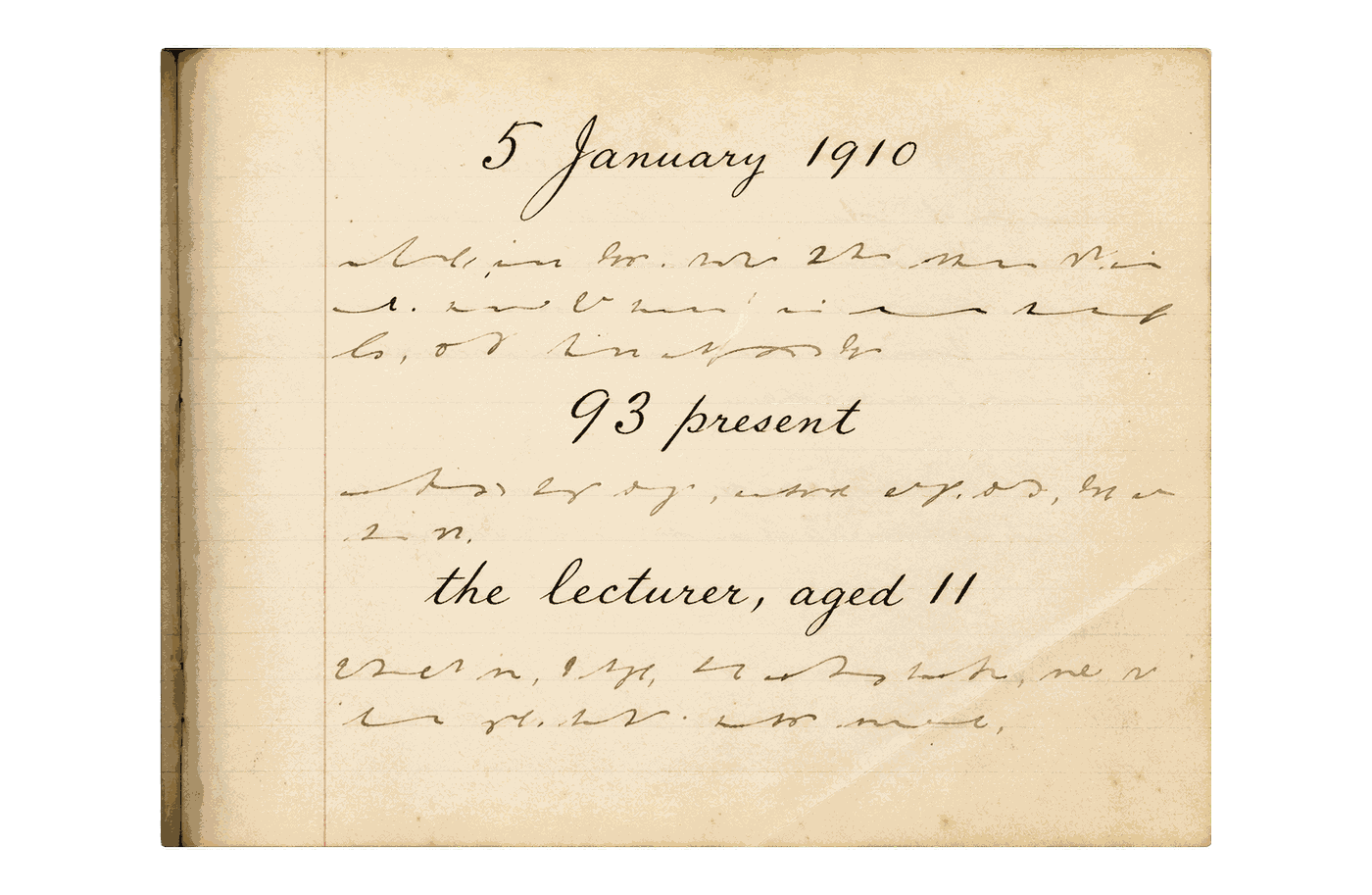
The membrane cuts on the way in as well: the self-concept shock is documented at entry, not mid-course, in the first term, when the reference class changes and the best of an old pond meets the new pond’s median. And the record’s cruelest case shows the membrane failing afterwards, permanently. On 5 January 1910, the Harvard Mathematical Club met to hear a lecture on four-dimensional bodies; the minutes record ninety-three people present; the lecturer, William James Sidis, was eleven years old. Thirty years later the adult Sidis sued The New Yorker over a profile a federal appeals court itself described as a ruthless exposure of a once public character, and he lost:
Great deeds had been expected of him, so his later history, containing the answer to whether he had fulfilled his early promise, remained a matter of public concern.
A revisionist case holds his obscure adult life was chosen, not ruined; either way, a court ruled that having been displayed as a prodigy at eleven forfeited his privacy at thirty-nine.
I am not arguing that immersive schools reliably break people; the quantitative boarding literature already given finds parity to small mixed effects on average, and the record will not support more. The supported claim is about location: Mill at the exit his education never imagined, the internat graduates at their abrupt graduation, Sidis billed to ninety-three strangers before he could consent to the promise made on his behalf. The hardest design problem of a genius school is not the curriculum. It is the boundary, and the join with the engine is exact: the engine’s entire value is that it replaces a child’s world, so the engine’s entire risk is that a replaced world must eventually be given back. A school that engineers its interior for years while improvising its boundary in the last week has built a decompression chamber with no airlock. The Kolmogorov School is therefore designed from the leaving backwards, and what follows is design, stated as design.
First, the exit is a curriculum, not an event. The alumna’s sentence is the specification in negative: nothing here may finish abruptly. The final year is decompression, term by term more of the week lived outside the wall with outside mentors, until the last day changes almost nothing; graduation ends a timetable, the alumni being the school’s second campus. Second, the crossing is drilled from the first year, borrowed openly from Jason Brennan’s Georgetown seminar on ambition, whose assignments are acts rather than essays: the Failure Project, attempting something the student will publicly fail at for thirty minutes; the Rejection Project, three requests the student fully expects to be refused; the Trading Project, trading upward from a one-dollar item; and his ethics course’s single assignment, think of something good to do, and do it. Built for college freshmen, with no outcome data, these are design material rather than science; but each rehearses a boundary, being unremarkable among strangers, being refused by an indifferent world, a supervised exit and re-entry repeated until the airlock is boring. Third, entry gets the same engineering: staged arrivals, an entry term overlapping the old life rather than amputating it, and the pond arithmetic said out loud on day one, that everyone here was the best of an old pond and half now sit below the new median, arithmetic rather than verdict; whether saying so blunts the effect is design intent, not measured remedy. Fourth, the afterwards: the school never spends its students’ childhoods as marketing, no showcases, no cameras, no child presented to ninety-three adults as an exhibit; the world learns a student’s name when the adult that student becomes decides to be known.
This movement’s failure condition belongs in the open. Everything above rests on mechanism and precedent, not controlled measurement; if longitudinal evidence ever shows that graduates of immersive selective schools have no elevated transition difficulty against matched peers, the airlock is expensive furniture. The school collects exactly that data on its own graduates, the fifth element arriving early.
The wager
The second belief from the opening now collects its due: a school on paper is utopian fantasy, untouchable by evidence. As a description of the genre, it is earned; the genre has never once broken form. László Polgár published Raise a Genius! in 1989:
Every healthy child can be raised to be one.
The hypothesis was genuine, laid out in courtship letters to his future wife before any of the children existed; the experiment was genuine too, three daughters, one method, total commitment. But the book appeared only after his eldest was already the top-rated woman in chess, a report written after the result, about his own children, by their father, with no record anywhere of what failure would have been allowed to look like. Boris Sidis ran the same play in 1911, publishing early training as the cornerstone of human life on the evidence of his own experience, and his experience was one child: his son, the eleven-year-old of the Harvard lecture. Terman tracked his 1,500 for decades with no comparison group, writing them recommendation letters as he went: mentorship, not science. In every case the same hand wrote the promise and marked the exam.
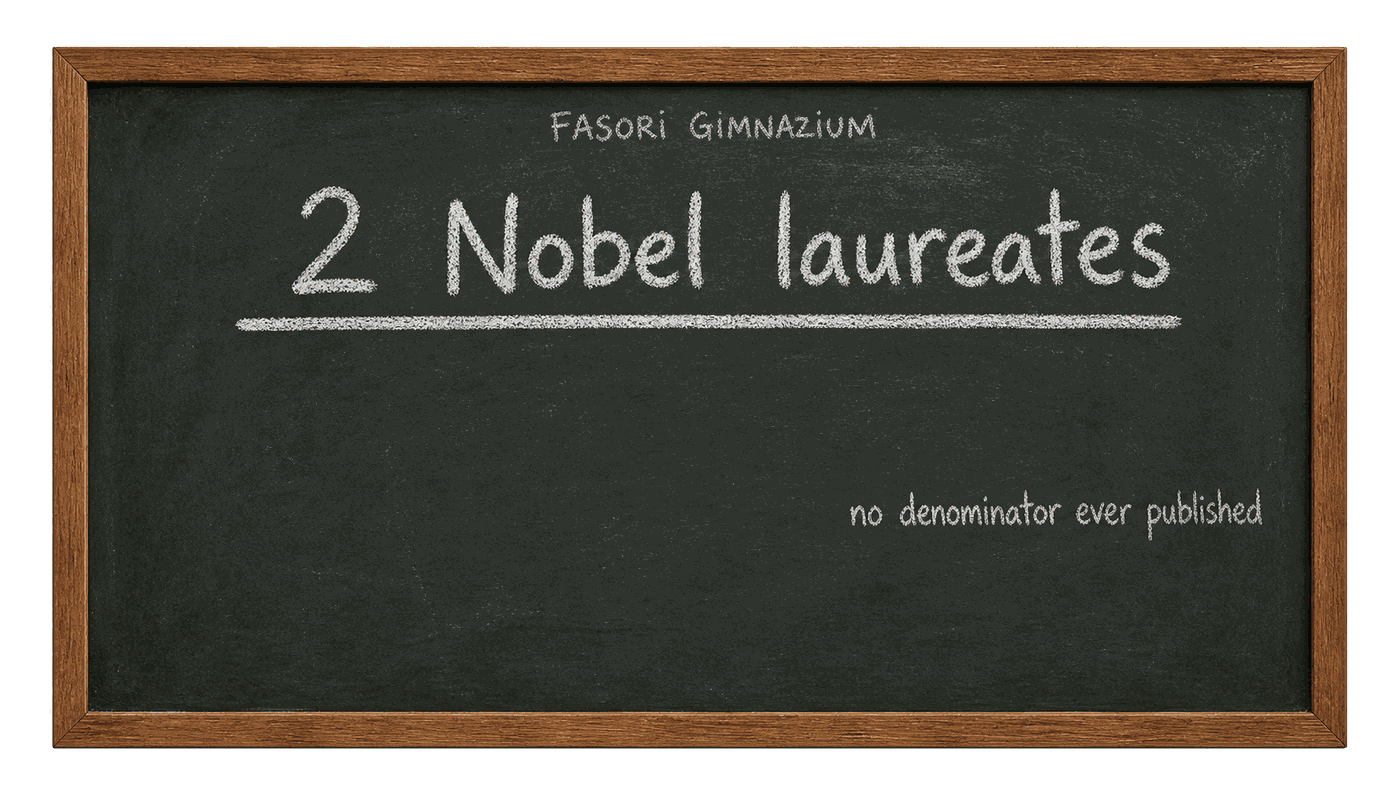
A century later the form is intact. Alpha School in Austin charges $40,000 a year and advertises learning at least twice as fast; its published evidence is a growth report of 154 matched testing events across the whole school, with no data at all for grades nine and ten, and its one gesture at independent analysis was the school’s principal feeding its own test data into two chatbots, the sections headed with the chatbots’ names. The Davidson Academy admits on a standard score of 145 on a named IQ test or on grade-indexed achievement, a sixth-grader qualifying with a 1280 on the SAT, and in two decades has published no outcome study of any kind, while its best-public-high-school ranking leans on average test scores at a school that admits on them. And the most famous genius school of all, Budapest’s Fasori Gimnázium, credited with two Nobel laureates and von Neumann, has enrolment figures no accessible source has ever published: a numerator with no denominator. One hundred years of schools for genius, and not one was built so that anyone could learn whether it worked.
There is an honest defence of the genre, and it points at its own refutation. A school’s job, the mild half says, is to teach, not to prove. The sharp half is Goodhart’s law:
When a measure becomes a target it stops being a measure.
So a pre-registered school will teach its registration, as exam schools already do. And measurement fails even in good faith:
Perry Preschool, the flagship trial of measured early education, rests on 123 children whose random assignment was compromised by reassignment after the draw.
If the flagship lists that badly, a school might reasonably teach well and stay silent.
But the best knowledge anyone has about elite schools was produced by accident, through oversubscription: a cutoff splits near-identical children across a line, and the comparison writes itself. The one time a genius-school claim was cashed, it was cashed at the margin, free, and the answer was selection, not teaching. An oversubscribed school already refuses children by the hundred, but by judgment, which teaches nothing; randomize the marginal band and the refusals become tickets worth keeping.
The Kolmogorov School keeps the tickets, and this is where the machine closes. The funnel exists because genius cannot be identified at a shapeable age; feeding 150 beds, it is built to produce a crowd of qualified applicants at the margin where any committee is guessing, and that margin is the instrument. Clear admits and clear rejections stand; at the margin, admission is randomised and both lists are kept. Before the first cohort enters, the school registers what it expects of its graduates at 25 and 35, long outcomes no term of teaching can bend, not test scores at sixteen, which Goodhart eats first. The data goes out in the open, null results included, collected from leavers by people the school does not employ; no teacher’s pay and no student’s place ever depends on a registered number. What the school refuses to measure matters as much: no per-child dashboards, no termly indicators, because a target ten years away is a poor thing to teach to. None of this drives the Goodhart risk to zero, and the residue is conceded: a school that knows what history will check leans toward the check.
The lottery has a cost with a face on it, the marginal child refused by a coin; the strongest form of the objection came from inside the genre’s first family. A sponsor once offered to fund László Polgár adopting three boys from a developing country, to be raised exactly as his daughters were: children sharing none of the family’s genes, the one control the method never had. László wanted to do it. Klara, his wife, talked him out of it, and the only genetic control in a century of genius education died in that conversation. The story survives in a single interview, held loosely here, but Klara’s veto is the ethics objection at full strength: a child is not an instrument, and a childhood is not a reading. About that experiment she was right; it makes children exist for the experiment’s sake. The lottery at the margin is the same idea inverted: the children exist anyway and the refusals happen anyway, in every oversubscribed school on earth, and the coin merely converts an arbitrary refusal into a recorded one. Only a recorded refusal ever teaches anyone anything.

And so the kill conditions; a charter that hides them has already died the fifth death. If boarding lotteries followed over decades come back null on long-run outcomes, the peer engine is dead, and with it the core of this design; the lottery result given earlier is test scores over a few years, not lives over thirty, and the decisive experiment has not been run. And if pre-registration demonstrably corrupts the education itself, Goodhart dominating everything the school does, the epistemic element fails, and an unfalsifiable good school would honestly beat a falsifiable worse one. The design on this page is mine, which seats me in the same chair as Polgár, Sidis and Terman; that is precisely why the outcomes go on record before the first child does.
The charter
The charter, one sentence per element. The school sits atop a national funnel of open competitions and journals, and admits demonstrated appetite, not measured genius. It is residential, entered in early adolescence, because the peer group is the curriculum and adolescence is when peers reach deepest. It is governed by floors: exposure to every domain, one made thing per term, sixty minutes of motion, no compulsory stillness; it mandates no path above them. Its exit is engineered from the first year, drilled through rehearsed crossings, finished by a decompression year, guarded by a refusal to spend childhoods as marketing. And it is run as an experiment that can fail in public: a lottery at the admission margin, outcomes registered before the first cohort, open data collected by outsiders.
Remove any element and a named predecessor stands waiting. Without the funnel, the school is Terman’s sieve, precisely selecting the wrong thing. Without the residence at the window, it is the Elite Illusion, selection theater with a fine prospectus. Without the floors, it is the overjustification trap at institutional scale, dismantling the appetite it selected. Without the airlock, it is the internat, Eden with a cliff at the door. Without the wager, it is Polgár’s book and Alpha’s spreadsheet, a promise marked by the hand that made it. Curriculum and teachers turn out to be the fifth or sixth question, and every predecessor that asked them first died one of the five deaths.
The conviction underneath the design is the one I started from:
We are actors of our own lives, and ambition plus the means to act is the core of an education.
The system above is that conviction as machinery a hostile reviewer could audit, because a school cannot lecture children into agency. It can compose the peers who make agency normal, refuse to mandate the path so the choosing stays theirs, rehearse the world until acting in it is unremarkable, and then submit its own grand claim to a coin and a registry.
If the argument holds, what follows is uncomfortable for both camps. Believers lose the founding myth, the great teacher at the blackboard, and inherit something less flattering: composition, floors, doors and paperwork. Sceptics lose the comfortable verdict that the whole idea is theater: one mechanism survived their own literature and has never been given its full-dose, long-horizon test. Whether the bet pays cannot be known in advance; the lotteries need decades, the registered outcomes mature when today’s thirteen-year-olds are thirty-five, and the design’s own standard forbids promising what the registry has not said. Kolmogorov wrote the funnel in a letter and was handed the house, and it took sixty years of evidence to show he had been right twice: the century’s failure was never one of ambition or of children, but of assembly. The machine his letter and his school describe has never once been built whole. That is the experiment worth running, and the only honest way to run it is so that it can be lost.
Curiosity of the week
Quote of the week
“Orandum est ut sit mens sana in corpore sano. One must pray for a sound mind in a sound body.”
Juvenal, Satire X, where it is not a curriculum but a prayer