marco@blog.luyckx.dev:~$ cat say-it-straight.md
Say it straight
$ git log --follow say-it-straight.md 1 edition
First published.
$ grep '^#\+' say-it-straight.md 3 headings
A few years ago I got a review back on a document I had written. It opened with “thanks, this is really great work”, listed three small suggestions, and closed with a fourth, phrased very gently: “it might also be worth considering whether the overall approach is the right one.”
I fixed the three small things and sent it back. Two weeks later I found out that the fourth bullet had meant, all along, “this is the wrong document, please write a different one.”
Oof.
Nobody in that story did anything wrong. The reviewer was being kind, and I was reading what was written. The information was in there. It was just wrapped so well that I threw it out with the paper.
So my email signature now carries one extra line:
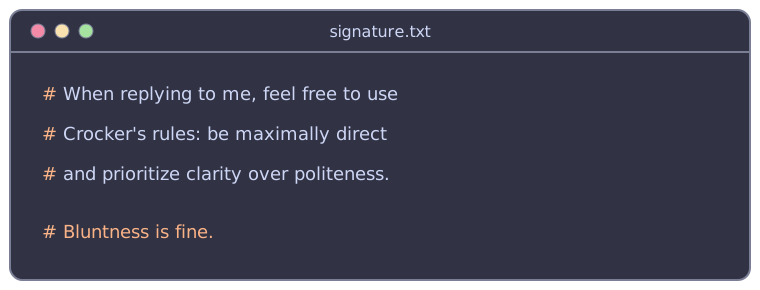
When replying to me, feel free to use Crocker’s rules: be maximally direct and prioritize clarity over politeness. Bluntness is fine.
Where the name comes from
Crocker’s rules are named after Lee Daniel Crocker, a programmer who, among other things, rewrote the software Wikipedia ran on in 2002 and co-authored the PNG image format. The short page that defines them lives on SL4, a mailing list Eliezer Yudkowsky ran in the early 2000s. Its first sentence is the whole idea:
Declaring yourself to be operating by “Crocker’s Rules” means that other people are allowed to optimize their messages for information, not for being nice to you.
The same page also says that anyone “is allowed to call you a moron and claim to be doing you a favor.”
Heh. Okay, that’s a bit more than I signed up for.
But look at what the rules are actually optimising for: information. “You’re a moron” carries almost none. “Your fix breaks when the list is empty” carries a lot. Bluntness takes the wrapping off. It does not add a punch.
Politeness is an encoding
Here is how I think about it. A polite message is the real message plus padding.
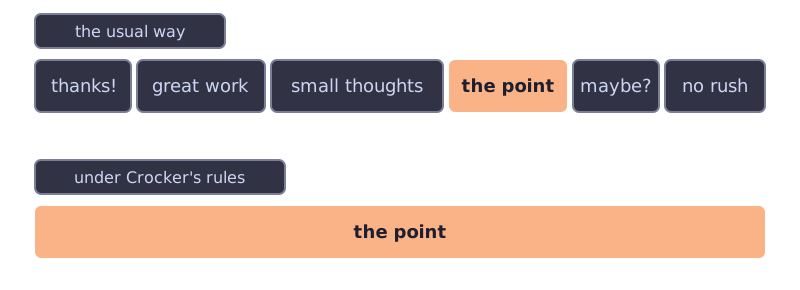
The sender pays to write the padding: the compliment to lead with, the soft word, the “maybe” that turns a no into a question. The receiver pays again to strip it off. And the stripping is lossy. Each side is guessing what the other can take, and when the guess is wrong, the actual point ends up in the bin with the padding. That is my review story in one sentence.
In my day job this gets expensive fast. I work in security, where “anyone on the internet can read your customer database” can get softened on its way through a meeting into “consider reviewing access controls”. Same fact. Very different Monday.
Crocker’s rules are a way of saying: skip the padding for me. I will do my own unwrapping, and I would rather you spent the time on the point.
The half that points at me
The most important sentences on that page are the ones people skip:
Note that Crocker’s Rules does not mean you can insult people; it means that other people don’t have to worry about whether they are insulting you. Crocker’s Rules are a discipline, not a privilege.
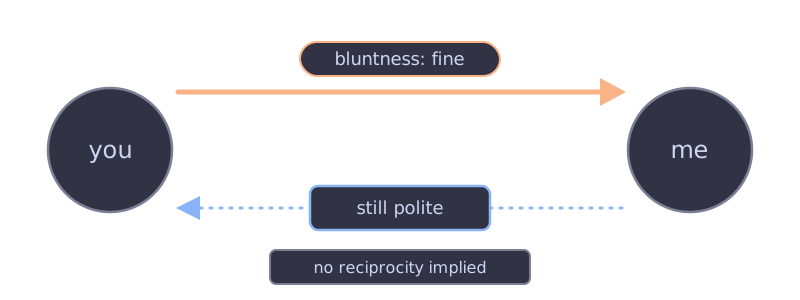
It is one-way. The line in my signature changes what you are allowed to send me. It does not change what I send you. I will still say hello, and I will still think about how my reply lands. The page is explicit that taking advantage of the rules “does not imply reciprocity”, and that feels right: you cannot give yourself permission to be rude by announcing that you are fine with rudeness.
It is also an offer, not a request. “Feel free” is doing real work in that line. If polite is how you write, write politely, and I will read it just fine. The rule only removes the obligation.
And then there is “if you’re offended, it’s your fault”, which is also on that page and is addressed to me, not to you. That one is a small promise. If you take me up on it and your reply stings, I owe you a thank-you, not a sulk. I suspect that is the hard part. Being told you are wrong is easy to welcome in the abstract and a lot less fun at 9:14 on a Tuesday morning.
So that is the line. It costs you nothing to ignore it, it saves us both time if you use it, and it commits me to one thing: when you say it straight, I hear it as the favour it is.
Curiosity of the week
Quote of the week
“Two people using Crocker's Rules should be able to communicate all relevant information in the minimum amount of time, without paraphrasing or social formatting.”
Crocker's Rules, as written up on sl4.org