marco@blog.luyckx.dev:~$ cat be-the-tap.md
Be the tap
$ git log --follow be-the-tap.md 1 edition
First published.
$ grep '^#\+' be-the-tap.md 3 headings
I recently read George Mack’s High Agency in 30 Minutes, and it opens with a question I have not been able to put down:
You wake up in a 3rd world jail cell. You’re only allowed to call one person you know to get you out of there. Who do you call?
I had a name in about two seconds. I suspect you did too.
Then a second question showed up, the one the essay is too polite to ask out loud. Would anybody call me?
Hmm.
Mack’s name for whatever that person has is high agency. He does not try very hard to define it, and his best line does not need him to:
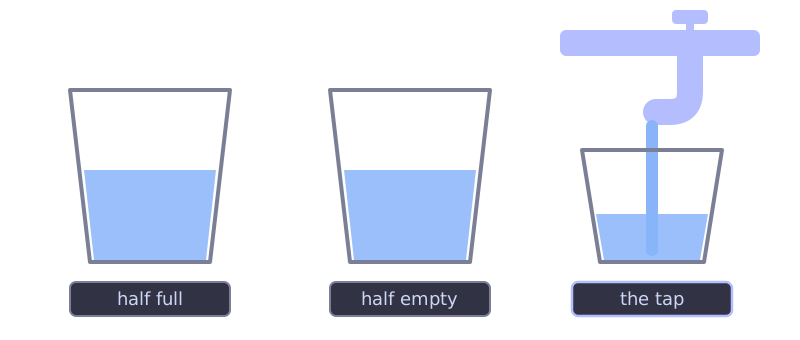
Optimism states the glass is half full. Pessimism states the glass is half empty. High agency states you’re a tap.
The person you would call is not more optimistic than everyone else. They just do not experience the future as weather, something that happens to them. They experience it as something you change with your hands, and they start changing it before anyone has finished explaining why it cannot be done.
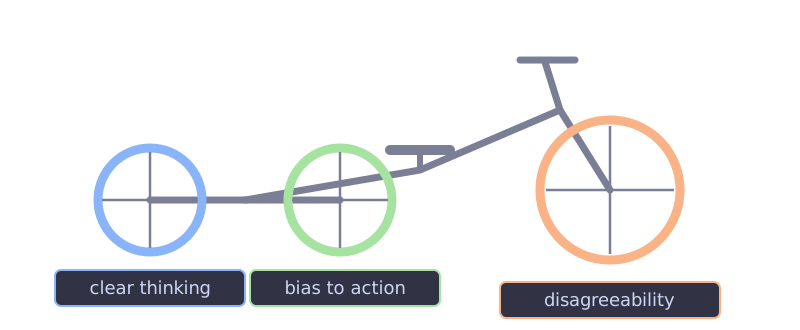
Mack splits it into three skills that rarely show up in the same person: clear thinking, a bias to action, and disagreeability, which here means being willing to go against the room. He calls it a tricycle, because if you take one wheel off, it falls over. Clear thinking without action is a podcast. Action without clear thinking is a lot of energy aimed at the wrong wall. And both together, without the nerve to disagree, end up doing what the room was going to do anyway, only faster.
Definitions do not do this idea justice, though. People do.
Three people who did not wait
Wilbur. In the winter of 1885–86, Wilbur Wright was eighteen, athletic, and very likely headed for Yale. During a hockey game on the ice, a local young man named Oliver Haugh hit him in the face with a stick. Wilbur spent the next years at home, unwell and depressed, nursing his mother, who was dying of tuberculosis. Yale quietly stopped being a plan.
What he did with those years was read. And at some point the reading turned into a question that most people around him found faintly ridiculous: if birds can fly, why can’t we? In 1899 he wrote to the Smithsonian asking for everything they had on flight. He and his brother Orville ran a bicycle shop in Dayton, Ohio, so they asked the Weather Bureau where in the country the wind was strongest and steadiest, and then took their gliders to Kitty Hawk, North Carolina, hundreds of miles from home.
Their 1901 glider produced about a third of the lift that the published tables predicted. Wilbur was crushed. He told Orville that man would not fly for fifty years.
Here is the part I love. They did not give up, and they did not write angry letters to the people who had published the tables. They built a wind tunnel in the shop and tested about two hundred wing shapes over the winter, then measured the best fifty or so properly. No engine was light enough for what they needed, so their mechanic, Charlie Taylor, built one in six weeks, with an aluminium block. On 17 December 1903, Wilbur flew 852 feet in 59 seconds.
He later admitted it himself:
I confess that in 1901 I said to my brother Orville that man would not fly for fifty years. Two years later we ourselves made flights.
That confession is my favourite thing in the whole story. High agency is not the absence of despair. Wilbur despaired, and then built a wind tunnel anyway.
Francis. Francis Ngannou started working in a sand quarry in Batié, Cameroon, when he was ten. At twenty-six he left with a plan to become a professional boxer in Paris, which, from a village in western Cameroon with no money, is less a plan than a sentence nobody around you takes seriously. He crossed Nigeria, Niger and Algeria into Morocco, on foot or in the back of smugglers’ trucks. He lived in a forest in Morocco and tried six times, over the course of a year, to cross into Spanish territory. When he finally made it, Spain held him for two months. In Paris he slept in a car park, until Fernand Lopez at the MMA Factory gym let him train there, and sleep there, for free.
In March 2021 he became the UFC heavyweight champion of the world.
Linus. In 1991 a 21-year-old student in Helsinki wanted an operating system for his new PC that worked the way he wanted. He did not have one, so he wrote one. His announcement on Usenet, in August, is famous for its modesty:
I’m doing a (free) operating system (just a hobby, won’t be big and professional like gnu) for 386(486) AT clones.
That hobby is Linux. Today it runs most of the world’s servers and sits inside every Android phone.
Nobody asked Linus. There was no permission, no credential, no team. A student had a problem and decided the problem was his.
Three very different lives, and the same move underneath each one. The problem did not break any law of physics, so it could be solved. And nobody else was coming to solve it.
One company that waited
Mack borrows a lovely low-agency example from Nassim Taleb: we put a man on the moon before anyone put wheels on suitcases. Everyone carried their suitcase because everyone else carried theirs.
My favourite is bigger, and sadder.
In December 1975, a young Kodak engineer named Steven Sasson finished the first self-contained digital camera. It weighed 3.6 kilograms, took black-and-white pictures of 100 by 100 pixels, and needed 23 seconds to write a single image onto a cassette tape. He showed it to management. By his own later account, their reaction was “that’s cute”, but “don’t tell anyone about it.”
To be fair to Kodak, the story usually told about this is too simple. They did not bury the camera in a drawer. They patented it, kept researching, and eventually sold a lot of digital cameras. Nobody there was stupid, and plenty of them could see where photography was going.
What they could not do was act against the thing that paid every salary in the building, which was film. So they watched the future arrive slowly, from close up, with the patent in hand. In January 2012, Eastman Kodak filed for bankruptcy.
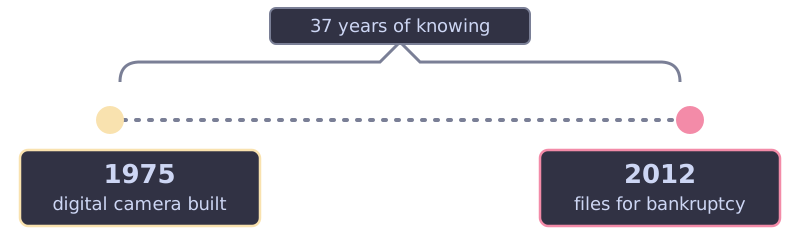
Look at it with the tricycle in mind. Clear thinking was never the problem: Kodak invented the thing. What was missing were the other two wheels: the action that would have hurt the film business, and the disagreement with their own room that it would have taken.
That is the uncomfortable part about low agency. It is rarely ignorance. Most of the time it is knowing, and waiting.
Why this matters more now
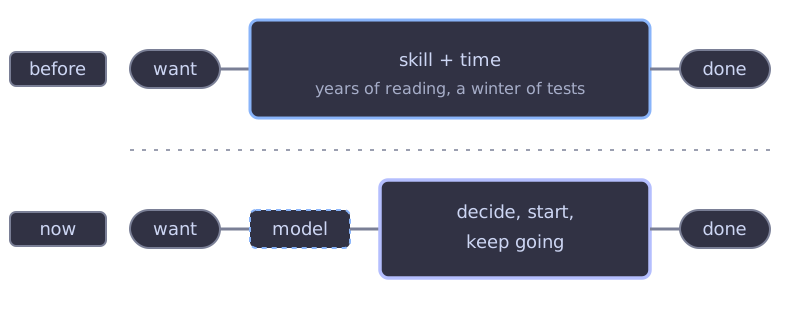
For most of history, the gap between wanting something done and being able to do it was filled with skill and time. Wilbur needed years of reading and a winter of wind-tunnel tests. Today a lot of that gap closes in an afternoon. You can ask a model for the code, the draft, the plan, or a summary of everything the Smithsonian would have mailed him in 1899.
So competence is getting cheap. And when something gets cheap, the bottleneck moves somewhere else. If anyone can produce a competent version of almost anything, the scarce thing is the person who decides what is worth making, starts, and keeps going when the first glider produces a third of the lift. That is not a skill a model has. It is the tricycle.
There is a second reason. A language model is built to give you the likely answer, and the likely answer is, almost by definition, the average one. That is a great default for a lot of tasks. It is a terrible default for a life. Mack has a line for this too:
Normal is forgotten. Only weird survives.
In a world flooded with competent, average output, the weird part is the only part that is clearly yours. Being your own person, completely, is no longer a personality quirk. It is the part nobody else can generate.
The third reason is about risk. Trying things used to be expensive. The glider pioneer Otto Lilienthal died after a crash in 1896, which is the kind of downside Wilbur was signing up for. Today, most experiments cost a weekend and a subscription. The cost of acting has collapsed. The cost of not acting has not, and in a world that moves faster, waiting costs more than it used to. Kodak had decades to make up its mind. I am not sure anyone gets decades now.
And the fourth: Mack’s rule that there are no adults. Nobody knows how this transition goes, including the people building it, who are working it out live like everyone else. If you are waiting for someone qualified to tell you it is fine to start, that person does not exist.
There is one trap here that I fell into myself. A few weeks ago I asked a model to plan me a weekend away. It made a lovely one: a museum, a long walk, a restaurant that turned out to be real. I read it, felt vaguely satisfied, and stayed home.
Heh. I had consumed the weekend.
That is the version of the AI future that worries me more than the dramatic ones. Not that the machine does things for us, but that we let it do the living, and become a very well-informed audience to our own lives. Used well, AI is an amplifier: it makes the tap bigger. It is not a replacement for the tap.
Now, the fine print, because this idea has a cheap imitation and an honest objection.
The cheap imitation is the person who mistakes being a jerk for disagreeability, and motion for action. Mack’s tricycle has three wheels on purpose. Disagreeing with the room without clear thinking is just noise.
The honest objection is that every story above is survivorship bias. For every Ngannou who reached Spain, other people died trying. Lilienthal is in this essay as a footnote, and nobody writes thirty-minute essays about the gliders that never came back. Agency is also not handed out evenly: it is easier to be disagreeable when you have savings.
All of that is true, and it changes how I would put the claim. The honest version is not “take risks and you will win”. It is narrower. Kodak placed a bet. So did everyone who carried their suitcase. Most of us place that bet many times a week, without noticing, because it does not feel like a decision.
Not acting is also a bet. You just never see yourself placing it.
So, back to the jail cell. I still do not know whether anyone would call me. But I know what the person they call does: when they hear “impossible”, a second conversation starts in their head. That is something I can practise. Today, even, and it has never been cheaper to start.
Curiosity of the week
Quote of the week
“When you're told that something is impossible, is that the end of the conversation, or does that start a second dialogue in your mind?”
Eric Weinstein, quoted in George Mack's High Agency in 30 Minutes