marco@blog.luyckx.dev:~$ cat average-by-definition.md
Average by definition
$ git log --follow average-by-definition.md 1 edition
First published.

I cannot get those to sit together. They are not two moods on two days. They are two pieces of advice, and they point in opposite directions.
There is a line going around online that puts the friction rudely: “It’s always the motherfuckers with no magic trying to tell you what to do with yours.” Nobody knows who wrote it. I went looking and found four or five wordings across as many platforms, plus a T-shirt, and no author attached to any of them.
The rude version is fun. The dry version is the one I can defend, and the dry version is arithmetic.
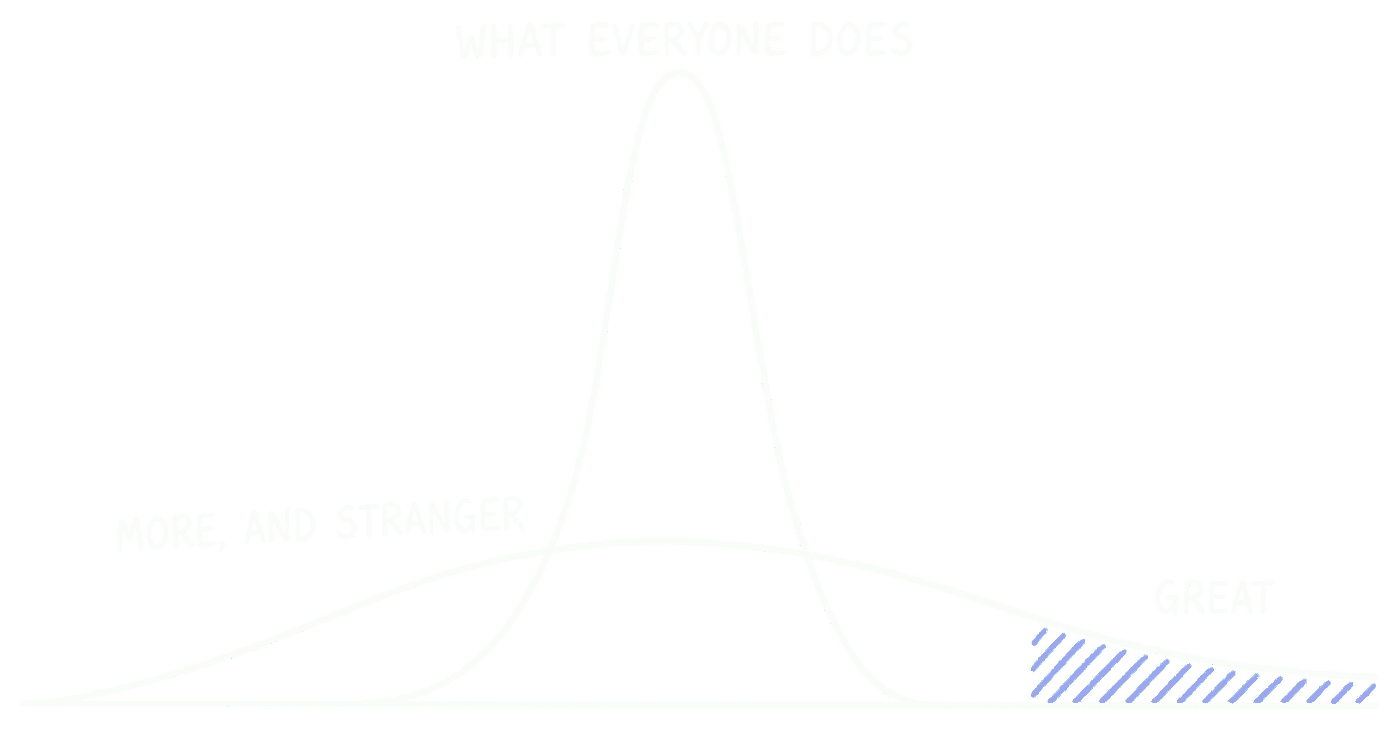
Doing exactly what everybody does makes you average. Not likely to be average, not usually average: average by definition. The average is the thing the crowd’s behaviour produces, which is what the word denotes. Greatness is the name we give to outcomes a long way from it. So the safe choice is not the absence of a bet, it is a bet on the mean, placed on the one outcome that greatness is defined against.
The shape of the payoff decides the answer
Whether the weird bet is stupid depends completely on how the payoffs are shaped, and this is where people who reason well about ordinary risk go wrong.
In his 2015 letter to Amazon shareholders, Bezos put it as a rule you can check:
Given a ten percent chance of a 100 times payoff, you should take that bet every time. But you’re still going to be wrong nine times out of ten.
Then he sets a sport beside it. Baseball’s outcomes are capped: however perfectly you connect, the most a single swing can produce is four runs. “In business, every once in a while, when you step up to the plate, you can score 1,000 runs.” When one loss costs an attempt and one win has no ceiling, the arithmetic points somewhere strange: swing more, and swing at odder pitches.
Swinging more is the second half of it. Dean Keith Simonton, a psychologist who spent a career counting what creative people produced, found that hits track total output: roughly, the person who makes more things makes more good things, and the ratio between them moves less than you would expect. The rule has been softened since he proposed it and should be held loosely, but the direction survives. “More things than average” is not a character note here, it is the variable that moves.
And the far end of the distribution cannot be reached by doing the ordinary thing harder. Distance from the mean requires variance, and variance, watched from outside before any result is in, is indistinguishable from being weird.
Nine in ten
Here is the part the motivational version leaves out. Nine of those bets lose. Not figuratively: the same sentence that says take the bet every time says you will be wrong nine times out of ten. The weird people you watched fail were not evidence against weirdness. They were the price of it, most of them paid it and got nothing back, and nobody wrote their names down anywhere.
So the claim only runs in one direction. Weirdness is necessary, not sufficient. “Not weird, not great” holds. “Weird, therefore great” is a fantasy, and the only reason it looks plausible is that the records we keep are records of winners.
Bezos concedes the rest of it in the same breath, and so should this: conventional wisdom is usually right. Contrarianism is not a virtue and being strange is not an achievement. The bet is worth taking because of the shape of the payoff, not because the crowd is stupid. Usually the crowd is correct.
And where the payoff has a ceiling, none of this applies. In a capped domain, where four runs is the best that any swing can do, the median strategy wins and the variance strategy only loses more often for no extra upside. A great deal of work is shaped that way. In that work the sensible people are right, and this argument is not about them.
Which leaves the line where I started. Read as an insult, it is a thing to feel good about for ten seconds. Read as arithmetic it turns almost gentle. The people with no magic, telling you what to do with yours, are describing the mean, and describing it accurately. It is a correct account of what usually happens to a person who does what they are told.
It is just not where you were trying to go.

Curiosity of the week
Quote of the week
“It's not the consequence that makes a problem important, it is that you have a reasonable attack.”
Richard Hamming, You and Your Research, 1986